
Finerenone linked to fewer sudden deaths across the CKM spectrum
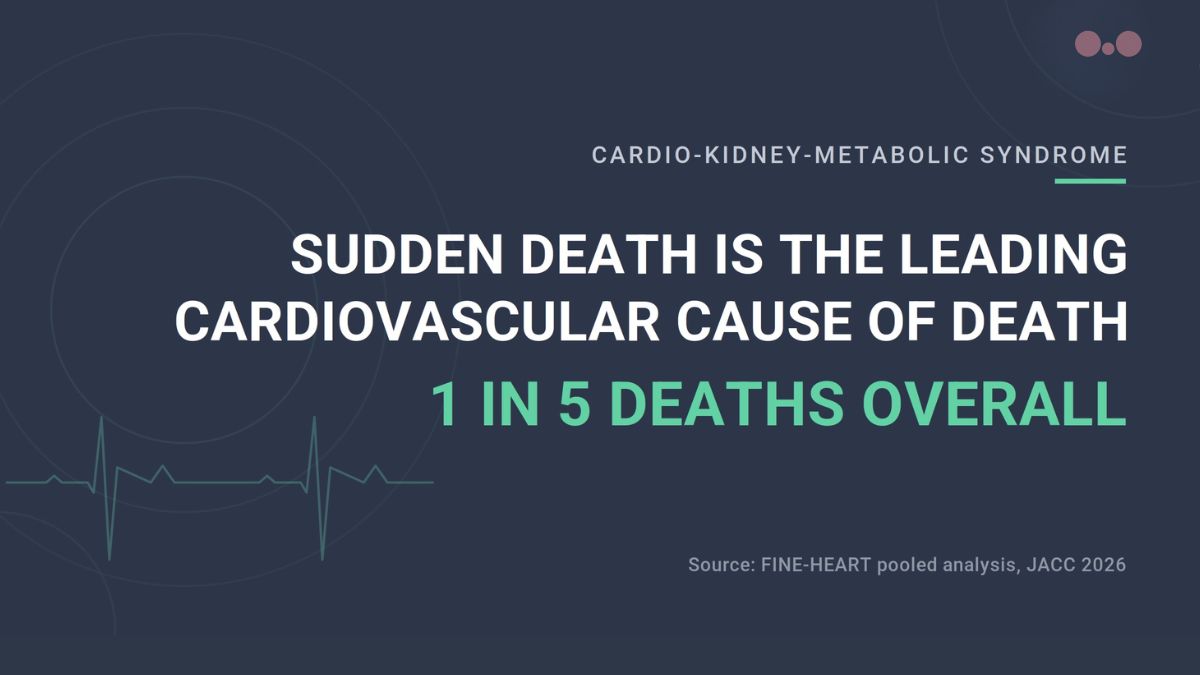
Sudden death is the single leading cardiovascular cause of death in cardio-kidney-metabolic syndrome, a pooled analysis of nearly 19,000 trial participants finds. Here is what the FINE-HEART data show, and what they mean for primary care.
Sudden death is becoming a significant but often overlooked cause of death in cardio-kidney-metabolic (CKM) syndrome. A new analysis shows that finerenone, a nonsteroidal mineralocorticoid receptor antagonist, is linked to a lower risk of sudden death.1
The FINE-HEART analysis looked at data from three placebo-controlled trials. It followed 18,991 participants for about 2.9 years.1
In the pooled population, sudden death was the top cause of cardiovascular deaths. It made up about 47% of these deaths and nearly one in five deaths overall, with an incidence of 0.8 per 100 patient-years. The burden tracked closely with disease stage.1
Participants with stage 4 CKM had almost three times the risk compared to those at stages 2 or 3 (HR 2.7; 95% CI 1.99 to 3.67). Absolute rates increased from 0.3 to 1.1 per 100 patient-years. In multivariable modelling, various baseline characteristics were linked to a higher risk:1
History of heart failure
Raised urine albumin-to-creatinine ratio
Atrial fibrillation
Prior myocardial infarction
Older age
In the treatment comparison, sudden death happened in 188 participants taking finerenone (2.0%) and in 230 on placebo (2.5%). This shows a lower risk with the active drug.1
Hazard ratio 0.81 (95% CI 0.67 to 0.98; P=0.034)
Roughly 19% lower relative risk
Absolute rate reduction of 0.16 per 100 patient-years
Number needed to treat of around 216
The signal remained consistent, no matter the CKM conditions, stage, or trial.1
Several caveats temper interpretation:1
FINE-HEART pools trials with various designs and entry criteria. None of them is individually powered for sudden death.
Experts adjudicated the causes of death without confirming them through autopsy.
The earliest CKM stages were not represented
What does this mean for primary care?
These are populations that sit largely within the primary care remit. Chronic kidney disease, type 2 diabetes, and heart failure with preserved or mildly reduced ejection fraction are often monitored in general practice.2 Finerenone is already used in the UK. NICE recommends it for stage 3 to 4 CKD with albuminuria in type 2 diabetes.2 Plus in 2026 it was also licensed in the UK for heart failure with an ejection fraction of 40% or above.
This analysis does not change any of that. It doesn't provide new insights and doesn't change dosing or monitoring. It relies on an exploratory pooled endpoint instead of a single focused trial.
However, what it does offers is a sharper view of the mortality landscape in these patients. Sudden death is now the main cause of cardiovascular deaths, not just a side issue. Also, a drug used for heart and kidney protection might help lower arrhythmic risk.1
For anyone weighing the cumulative evidence behind finerenone, it broadens the context without rewriting the rules.
Foà A, Pabon MA, Filippatos G, et al. Effects of finerenone on sudden death across the cardio-kidney-metabolic landscape: a FINE-HEART analysis. J Am Coll Cardiol. 2026; published online ahead of print. https://doi.org/10.1016/j.jacc.2026.04.045
Finerenone for treating chronic kidney disease in type 2 diabetes. NICE technology appraisal guidance TA877. https://www.nice.org.uk/guidance/ta877
Enjoyed this article?
- ✓Unlimited access to clinical evidence articles
- ✓Weekly newsletter with clinical evidence
- ✓Free for registered healthcare professionals
Upcoming CPD: reducing cardiovascular risk in CKD
Join Beverley Bostock, RGN, MSc, MA, for a practical primary-care session on catching CKD earlier and reducing cardiovascular risk.
View the free 1 CPD point CKD webinar