
Finerenone may slow kidney decline in glomerular disease
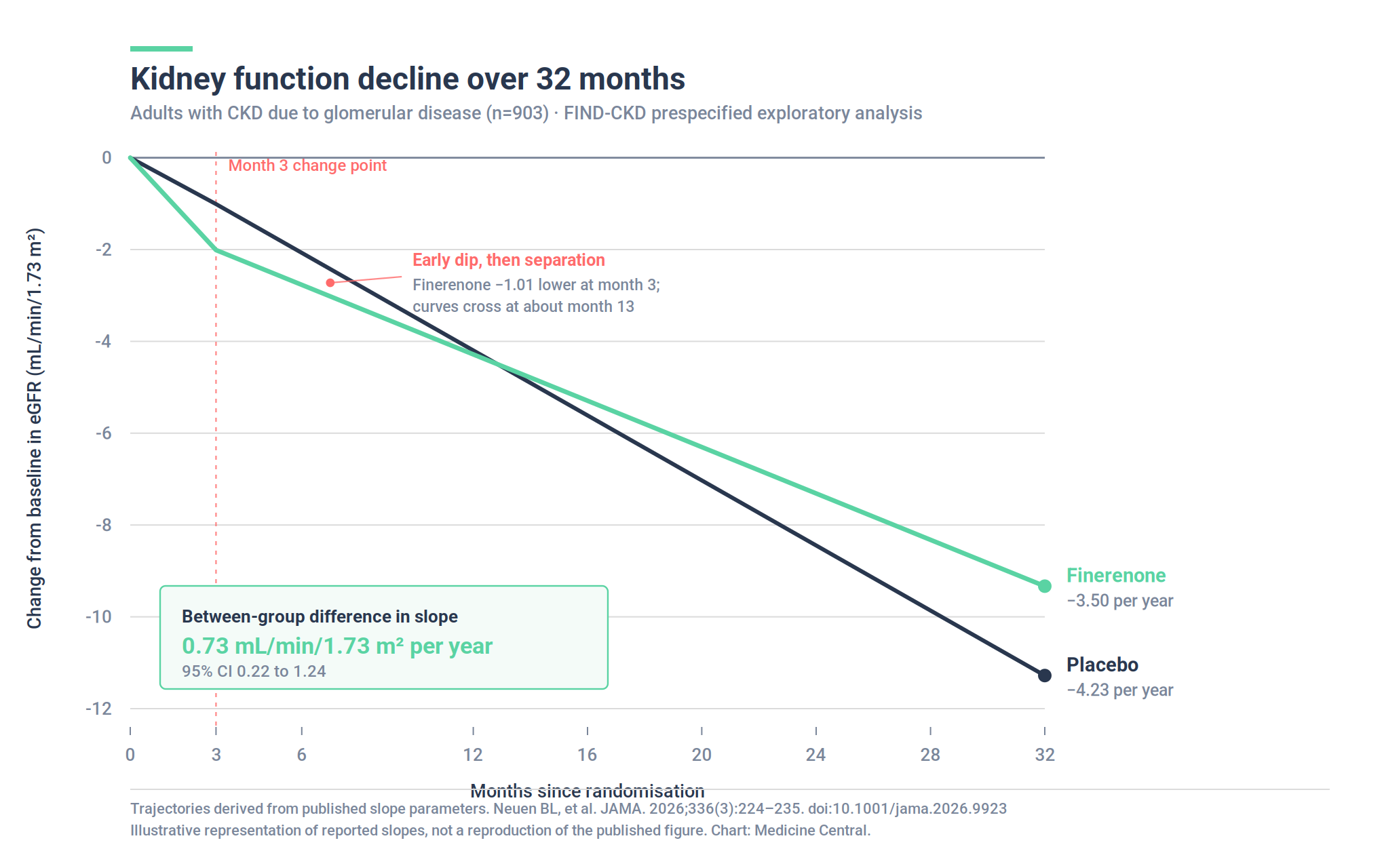
A prespecified exploratory analysis of the FIND-CKD trial reports slower eGFR decline with finerenone in chronic kidney disease due to glomerular diseases.
A prespecified exploratory analysis of the FIND-CKD trial reports slower eGFR decline with finerenone in chronic kidney disease due to glomerular diseases.
What the trial did
FIND-CKD randomised 1,584 adults with non-diabetic chronic kidney disease across 24 countries and regions to finerenone 10 mg or 20 mg once daily or matching placebo, added to a stable maximum tolerated dose of an ACE inhibitor or angiotensin receptor blocker. This analysis covers the 903 participants (57.0%) with an investigator-reported glomerular disease: 416 with IgA nephropathy, 215 with focal segmental glomerulosclerosis and 90 with membranous nephropathy. Mean age was 51.1 years, mean eGFR 48.8 mL/min/1.73 m² and median urinary albumin to creatinine ratio 839.6 mg/g. Entry required a screening serum potassium of 4.8 mmol/L or less. Participants taking immunosuppression, and those with lupus nephritis or ANCA-associated vasculitis, were excluded.
What it found
Total eGFR slope to month 32 was −3.50 mL/min/1.73 m² per year with finerenone against −4.23 with placebo, a between-group difference of 0.73 (95% CI 0.22 to 1.24). Albuminuria fell by 42% at 12 months (95% CI 35% to 48%). The composite of kidney failure or a sustained eGFR decline of 40% or more occurred at 7.42 versus 9.60 events per 100 patient-years (HR 0.74, 95% CI 0.57 to 0.97). Effects were consistent across disease subtypes and irrespective of baseline SGLT2 inhibitor use, although only around one in five participants were taking one. Serious adverse events occurred in 19.5% versus 21.4%, and serious hyperkalaemia in 0.9% of both arms.
Figure 1. Change from baseline in eGFR over 32 months in participants with chronic kidney disease due to glomerular disease. Trajectories are derived from the slope parameters reported by Neuen and colleagues and are an illustrative representation, not a reproduction of the published figure.
How strong is this
This was a prespecified but exploratory subgroup analysis. P values are descriptive, no adjustment was made for multiplicity, and the trial was not powered for these outcomes in this population. Around a fifth of participants had no available biopsy, though results held in biopsy-confirmed cases. The trial was funded by Bayer.
What this means for primary care
Nothing changes at the prescribing pad this week. Finerenone is not licensed in the UK for non-diabetic CKD and NICE has not appraised it in this population, so any use here would sit with nephrology.
The relevance is closer to the shared-care interface. Patients with IgA nephropathy or focal segmental glomerulosclerosis are increasingly likely to arrive back in general practice on a non-steroidal MRA alongside a RAS inhibitor, and the potassium and renal function monitoring that follows lands in primary care. Worth noting too that finerenone produced an early eGFR reduction of around 1 mL/min/1.73 m² by month 3, with separation from placebo emerging later; the authors describe this pattern as underscoring the need for persistent treatment, in the same way clinicians already recognise the initial dip seen with RAS inhibitors and SGLT2 inhibitors.
Read alongside NICE's recent final draft guidance on finerenone in heart failure with preserved and mildly reduced ejection fraction, the wider signal is a drug steadily expanding beyond its diabetic kidney disease origins.
Reference
Neuen BL, Perkovic V, Agarwal R, et al. Finerenone in patients with chronic kidney disease due to glomerular diseases: a randomized clinical trial. JAMA. 2026;336(3):224–235. doi:10.1001/jama.2026.9923
Enjoyed this article?
- ✓Unlimited access to clinical evidence articles
- ✓Weekly newsletter with clinical evidence
- ✓Free for registered healthcare professionals