
Biggest weight loss, biggest trade-off?
A BMJ network meta-analysis of 262 trials and 99,791 participants compares 19 obesity drugs. The ranking matters less than what sits behind each position.
A BMJ network meta-analysis combined 262 randomised trials with 99,791 participants to compare 19 drugs for adults who were overweight or obese. The key takeaway is not the ranking itself, but the cost linked to each position.1
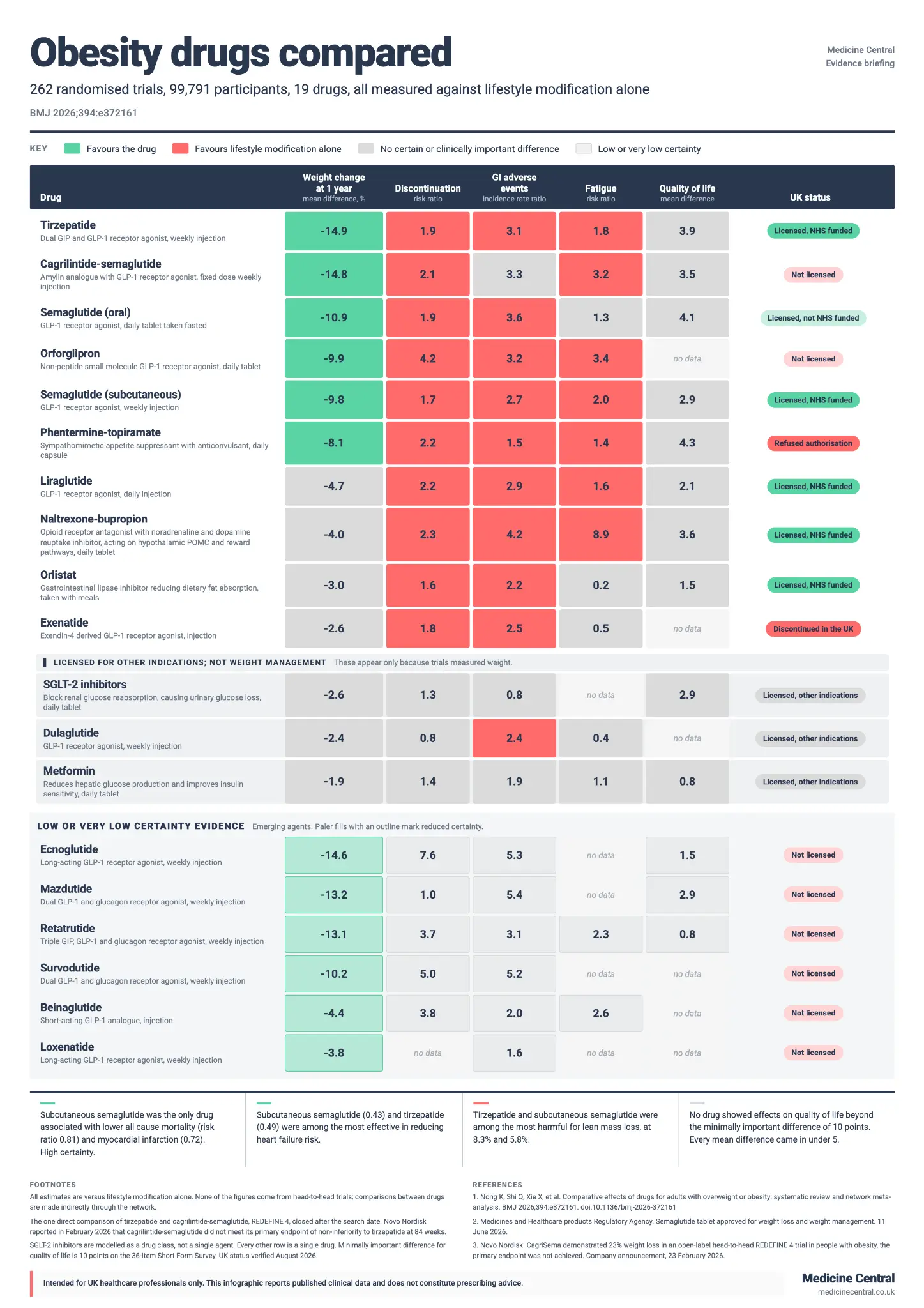
Tirzepatide showed a mean difference of −14.9% (95% CI −16.0% to −13.9%) against lifestyle changes alone at one year. Cagrilintide-semaglutide had a mean difference of −14.8% (−16.9% to −12.7%). Both were rated as very effective based on moderate to high certainty evidence. Oral semaglutide (−10.9%), orforglipron (−9.9%), subcutaneous semaglutide (−9.8%), and phentermine-topiramate (−8.1%) were in the moderately effective group.
Tirzepatide versus cagrilintide-semaglutide
The two are not separable on indirect evidence alone. Neither figure comes from a direct trial. The confidence intervals overlap almost entirely, so the analysis places them in the same category instead of ranking one above the other. In February 2026, Novo Nordisk announced that cagrilintide-semaglutide did not achieve its main goal of being non-inferior to tirzepatide after 84 weeks. This was the only direct comparison, REDEFINE 4.3
UK relevance thins the field
Cagrilintide-semaglutide has no licence anywhere. Orforglipron is still under MHRA review. Phentermine-topiramate is only approved in the United States. Oral semaglutide was licensed for weight management in the UK on 11 June 2026, though it is not yet NHS funded.2
Harms tracked benefit
Discontinuation due to adverse events was highest with orforglipron (risk ratio 4.2). Gastrointestinal events were most common with naltrexone-bupropion (incidence rate ratio 4.2). Fatigue happened more often with naltrexone-bupropion, with a risk ratio of 8.9 — equivalent to 331 more cases per 1,000 people over a year. Tirzepatide was among the most effective in reducing fat mass, at 25.7%, and among the most harmful in reducing lean mass, at 8.3%.
Two findings carry beyond weight
Subcutaneous semaglutide was the only drug linked to lower overall mortality (risk ratio 0.81, 95% CI 0.72 to 0.93) and myocardial infarction (0.72, 0.61 to 0.85). These results mainly came from cardiovascular trials in high-risk groups, not the average person seeking a weight loss treatment. And despite reductions of up to 15% of body weight, no drug showed effects on quality of life beyond the minimally important difference of 10 points. All mean differences came in under 5.
Greatest weight loss, in other words, is not the same question as greatest benefit.
References
- Nong K, Shi Q, Xie X, et al. Comparative effects of drugs for adults with overweight or obesity: systematic review and network meta-analysis. BMJ 2026;394:e372161. doi:10.1136/bmj-2026-372161
- Medicines and Healthcare products Regulatory Agency. Semaglutide tablet approved for weight loss and weight management. 11 June 2026.
- Novo Nordisk. CagriSema demonstrated 23% weight loss in an open-label head-to-head REDEFINE 4 trial in people with obesity, the primary endpoint was not achieved. Company announcement, 23 February 2026.
Enjoyed this article?
- ✓Unlimited access to clinical evidence articles
- ✓Weekly newsletter with clinical evidence
- ✓Free for registered healthcare professionals