
MASH: where the field is heading, and where primary care starts

New MASH licences clarify the fibrosis stages they cover, while the staging pathway remains the practical question for primary care.
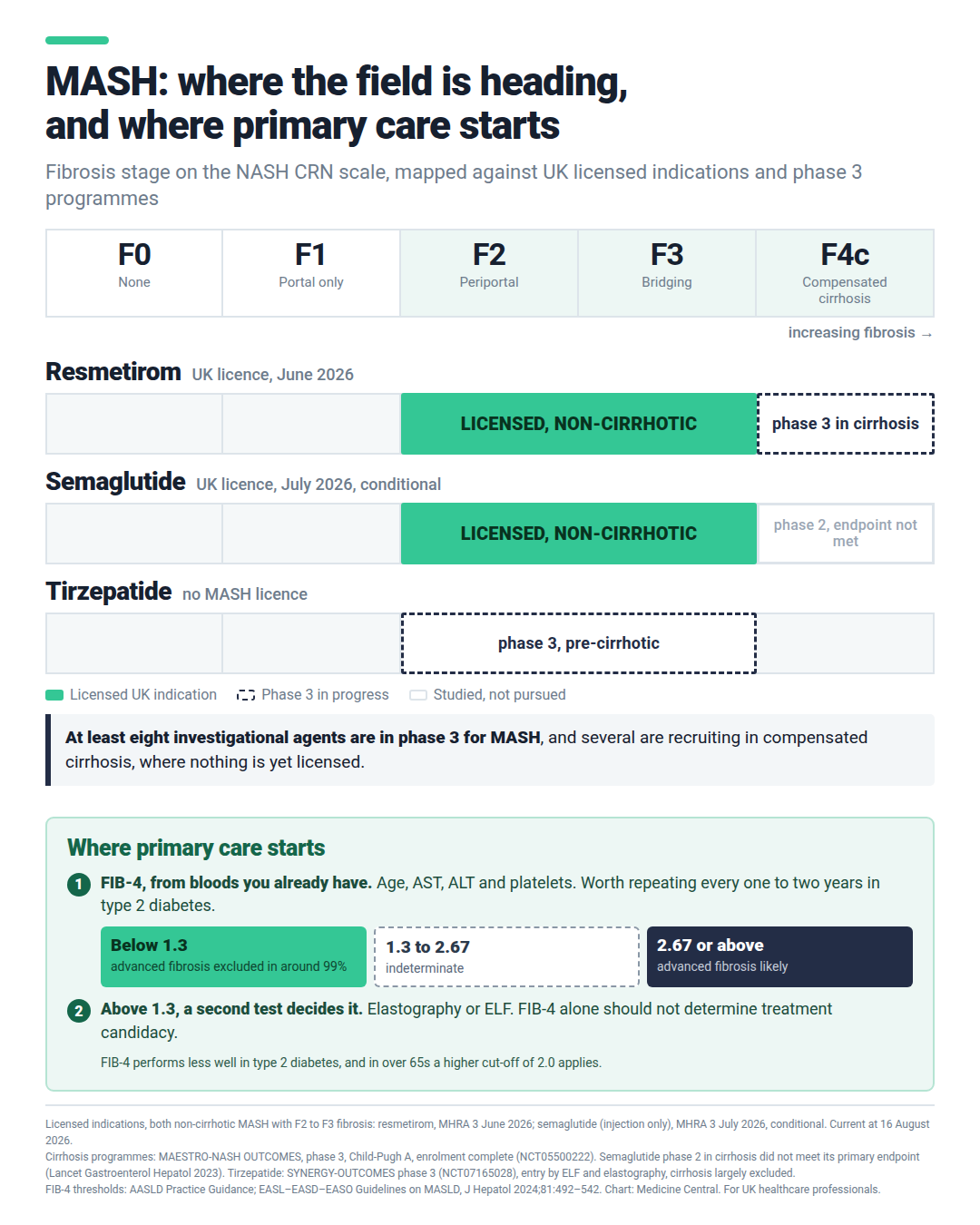
Two medicines picked up UK licences for metabolic dysfunction-associated steatohepatitis this summer, and the labels are unusually explicit about where they stop.
Both are licensed for non-cirrhotic MASH with moderate to advanced fibrosis, stages F2 to F3. A thyroid hormone receptor beta agonist in June.1 A GLP-1 receptor agonist in July, under a conditional marketing authorisation, and in the UK that indication sits on the injection rather than the oral tablets.2 Neither has completed NICE appraisal, so there is no national funding mandate. That is a commissioning position rather than a clinical one.
What sits past the licence
Compensated cirrhosis has no licensed treatment anywhere, and it is where the field is now pushing.
The thyroid hormone receptor beta agonist has a phase 3 outcomes trial in Child-Pugh A cirrhosis, with enrolment complete.3 The GLP-1 receptor agonist has already been there: a phase 2 trial in cirrhosis did not meet its primary endpoint, and no phase 3 followed.4 The GIP/GLP-1 receptor agonist is in phase 3, but below cirrhosis rather than in it.5
At least eight investigational agents are now in phase 3 for MASH, and several are recruiting in compensated cirrhosis. One detail is worth borrowing. Entry to several of these trials runs on ELF and elastography rather than biopsy, which is the same direction primary care is being asked to move.
Where primary care starts
FIB-4 is the recommended initial test. Age, AST, ALT and platelets, all already sitting in the record, and worth repeating every one to two years in type 2 diabetes.6 Below 1.3 it excludes advanced fibrosis in around 99% of people, and around 95% of those with multiple cardiometabolic risk factors.7
Above 1.3 it does less work. AASLD is explicit that FIB-4 should not be the single test deciding treatment candidacy, and 1.3 to 2.67 is where it is least informative.7 It also performs less well in type 2 diabetes, and in over 65s a higher cut-off of 2.0 applies.8
So FIB-4 sorts out who can be reassured. A second test, usually elastography or ELF, settles the rest. That second step is the part of the pathway most worth checking locally, because it is where identification either continues or stops.
Intended for UK healthcare professionals only.
- MHRA. Resmetirom (Rezdiffra) authorised to treat metabolic dysfunction-associated steatohepatitis in adults. 3 June 2026.
- Wegovy 2.4 mg solution for injection. Summary of Product Characteristics, section 4.1. Updated 10 July 2026.
- MAESTRO-NASH OUTCOMES. Phase 3, well-compensated MASH cirrhosis. NCT05500222. Enrolment complete.
- Loomba R, et al. Semaglutide in compensated cirrhosis due to NASH: a randomised, placebo-controlled phase 2 trial. Lancet Gastroenterol Hepatol. 2023.
- SYNERGY-OUTCOMES. Phase 3, NCT07165028. Recruiting.
- AASLD. Practice Guidance on the clinical assessment and management of MASLD.
- AASLD. Semaglutide therapy for MASH: 2025 Practice Guidance update.
- EASL-EASD-EASO. Clinical Practice Guidelines on the management of MASLD. J Hepatol. 2024;81:492-542.
Medicine Central is a clinical evidence review for UK primary care prescribers. For qualified healthcare professionals only.
Enjoyed this article?
- ✓Unlimited access to clinical evidence articles
- ✓Weekly newsletter with clinical evidence
- ✓Free for registered healthcare professionals
On-demand CPD: abnormal liver blood tests and MASLD
Watch Dr Kevin Fernando's on-demand session on a structured primary-care approach to abnormal liver blood tests and MASLD.