
Triglyceride-associated cardiovascular risk: Leaving risk on the table
Despite excellent LDL-cholesterol management, 1 in 3 patients with established ASCVD will experience a recurrent event within three years. Elevated triglycerides represent a major — yet frequently overlooked — driver of residual cardiovascular risk. Moudy Khodadi, Advanced Pharmacist Lipid Clinic, explains the mechanism, the evidence, and what actually works.
Where LDL-C management has got us
It has been over thirty years since the original 4S trial (Scandinavian Simvastatin Survival Study Group, 1994).1 Since then, the therapeutic landscape for LDL-cholesterol — our primary risk marker for atherosclerotic cardiovascular disease (ASCVD) — has transformed considerably. High-intensity statins, ezetimibe, bempedoic acid, inclisiran, and PCSK9 inhibitors are all potent agents for lowering LDL-C, and each helps reduce cardiovascular risk in very high-risk patients. A 1 mmol/L reduction in LDL-C is associated with a 22% relative risk reduction.2 These tools allow us to make meaningful, measurable changes to a patient's risk profile.
A residual risk gap remains
Patients can have their LDL-cholesterol lowered to the ESC target of below 1.4 mmol/L — and still experience cardiovascular events in the years that follow.
1 in 5 patients will experience another ASCVD event within 12 months of their heart attack or stroke, and 1 in 3 will have a further event within three years. This gap between optimised LDL-C and recurrent events demands our attention. Elevated triglycerides are a major — yet frequently overlooked — driver of this residual risk, and importantly, they can be managed.
The mechanism: how triglycerides add to plaque burden
LDL-cholesterol is relatively straightforward in its atherogenicity: it carries Apolipoprotein-B (ApoB), which crosses the arterial endothelium and contributes to plaque formation, resulting in ASCVD.
Elevated triglycerides, however, indicate high circulating levels of triglyceride-rich lipoproteins (TRLs) and their remnant particles. Unlike LDL particles, these remnants do not need to be small to penetrate the endothelium — they enter the arterial wall directly, adding to existing plaque burden or initiating new lesions.
Raised remnant cholesterol has been shown to cause ischaemic heart disease independently of LDL-C levels.3 Triglycerides are also an independent cardiovascular risk factor, not confounded by LDL-C.4
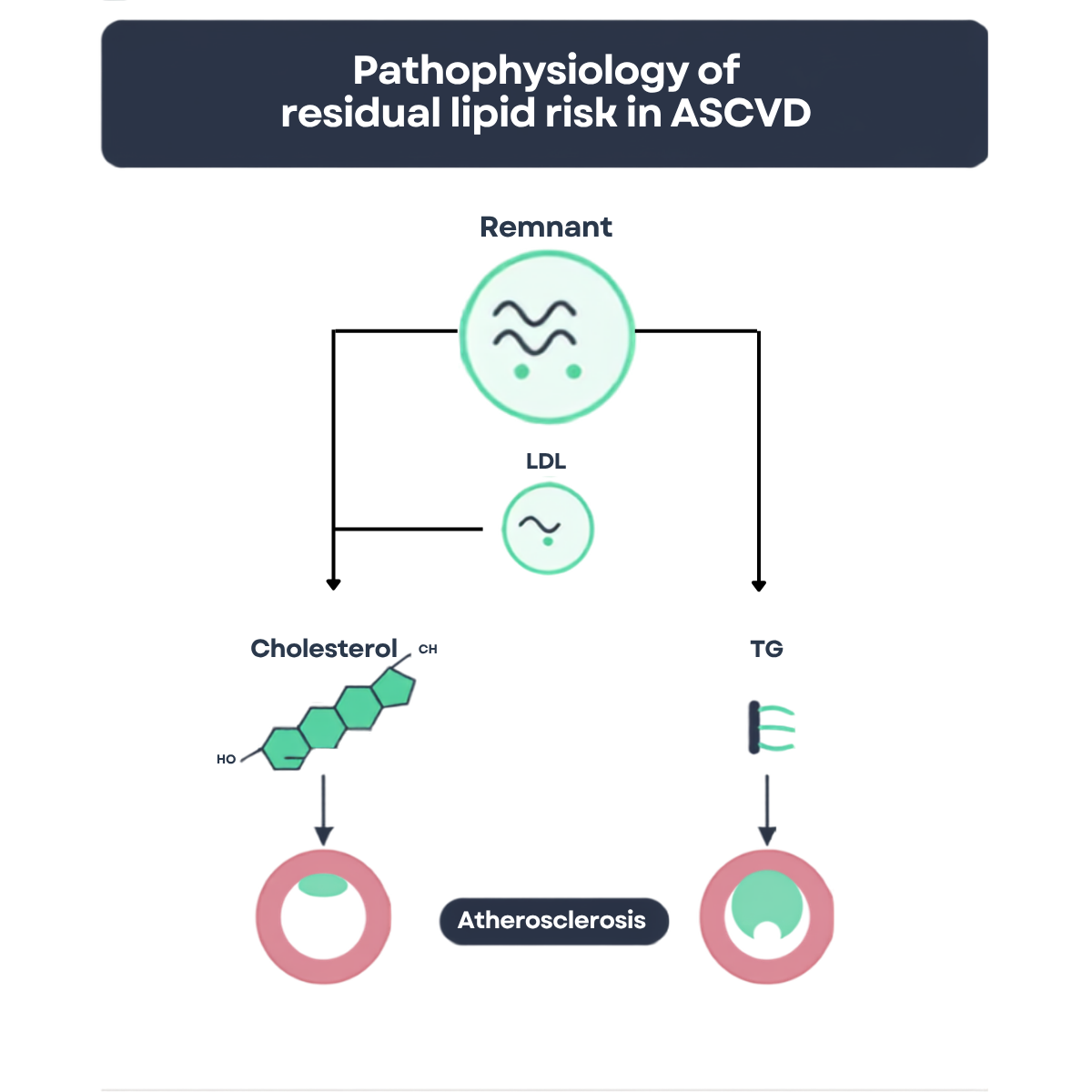
Pathophysiology of residual lipid risk in ASCVD. Both LDL and remnant particles contribute to atherosclerosis — via cholesterol and triglyceride pathways respectively.
The critical point is that the triglyceride risk pathway does not compete with LDL-cholesterol — it adds to it. If LDL-C is well managed but triglycerides are left unaddressed, the relative contribution of triglyceride-mediated risk becomes proportionally greater. Optimising LDL-C while ignoring triglycerides is not complete risk management — it is risk management with a blind spot.
What does not work
Fibrates, niacin, and standard omega-3 preparations all reduce triglyceride levels. However, none have demonstrated a reduction in cardiovascular events when added to statin therapy in large randomised trials (ACCORD, AIM-HIGH, HPS2-THRIVE). Triglyceride lowering alone is not a validated surrogate for cardiovascular event reduction, though these agents do retain a role in reducing pancreatitis risk in severe hypertriglyceridaemia.
What does work
The REDUCE-IT trial (Bhatt et al., 2019)5 was pivotal in establishing a management option for triglyceride-associated cardiovascular risk. The trial randomised statin-treated patients with triglyceride levels of 1.52–5.63 mmol/L and either established cardiovascular disease or diabetes with additional risk factors to receive either icosapent ethyl (IPE) or placebo.
The results demonstrated a 25% relative risk reduction in the composite of myocardial infarction, stroke, revascularisation, and cardiovascular death. Icosapent ethyl is the only triglyceride-directed intervention to demonstrate clear event benefits alongside statin therapy. NICE (TA805, 2021)6 now specifically recommends it for this patient group.
Summary
In cardiovascular risk management (CVRM) clinics, a full lipid profile is not optional — it is essential for complete risk assessment. Managing patients holistically across all lipid fractions is fundamental to reducing overall cardiovascular risk.
Using the correct terminology, identifying the right patients, and initiating evidence-based therapy are the starting points. Empowering patients to understand the significance of different lipid metrics — not just their cholesterol — is equally important. Sustained treatment to target, across all modifiable risk factors, is where we can make a genuine population-level impact and reduce the burden of recurrent cardiovascular events.
References
Scandinavian Simvastatin Survival Study Group. Randomised trial of cholesterol lowering in 4444 patients with coronary heart disease: the Scandinavian Simvastatin Survival Study (4S). The Lancet. 1994;344(8934):1383–1389.
Sabatine MS, Wiviott SD, Im K, Murphy SA, Giugliano RP. Efficacy and safety of further lowering of low-density lipoprotein cholesterol in patients starting with very low levels: a meta-analysis. JAMA Cardiol. 2018;3(9):823–828.
Ference BA, et al. Association of triglyceride-lowering LPL variants and LDL-C-lowering LDLR variants with risk of coronary heart disease. JAMA. 2019;321(4):364–373.
Sarwar N, et al. Triglycerides and the risk of coronary heart disease: 10,158 incident cases. Circulation. 2010;122(1):64–73.
Bhatt DL, et al. Cardiovascular risk reduction with icosapent ethyl for hypertriglyceridaemia. N Engl J Med. 2019;380:11–22.
NICE. Icosapent ethyl with statin therapy for reducing the risk of cardiovascular events in people with raised triglycerides (TA805). 2021.
NICE NG238. Cardiovascular disease: risk assessment and reduction, including lipid modification. 2023.
Enjoyed this article?
- ✓Unlimited access to clinical evidence articles
- ✓Weekly newsletter with clinical evidence
- ✓Free for registered healthcare professionals
On-demand CPD: cardiovascular risk in primary care
Watch Prof Ahmet Fuat's on-demand session on assessing cardiovascular risk beyond traditional tools.