
Once-weekly basal insulin now has a UK licence and a NICE recommendation
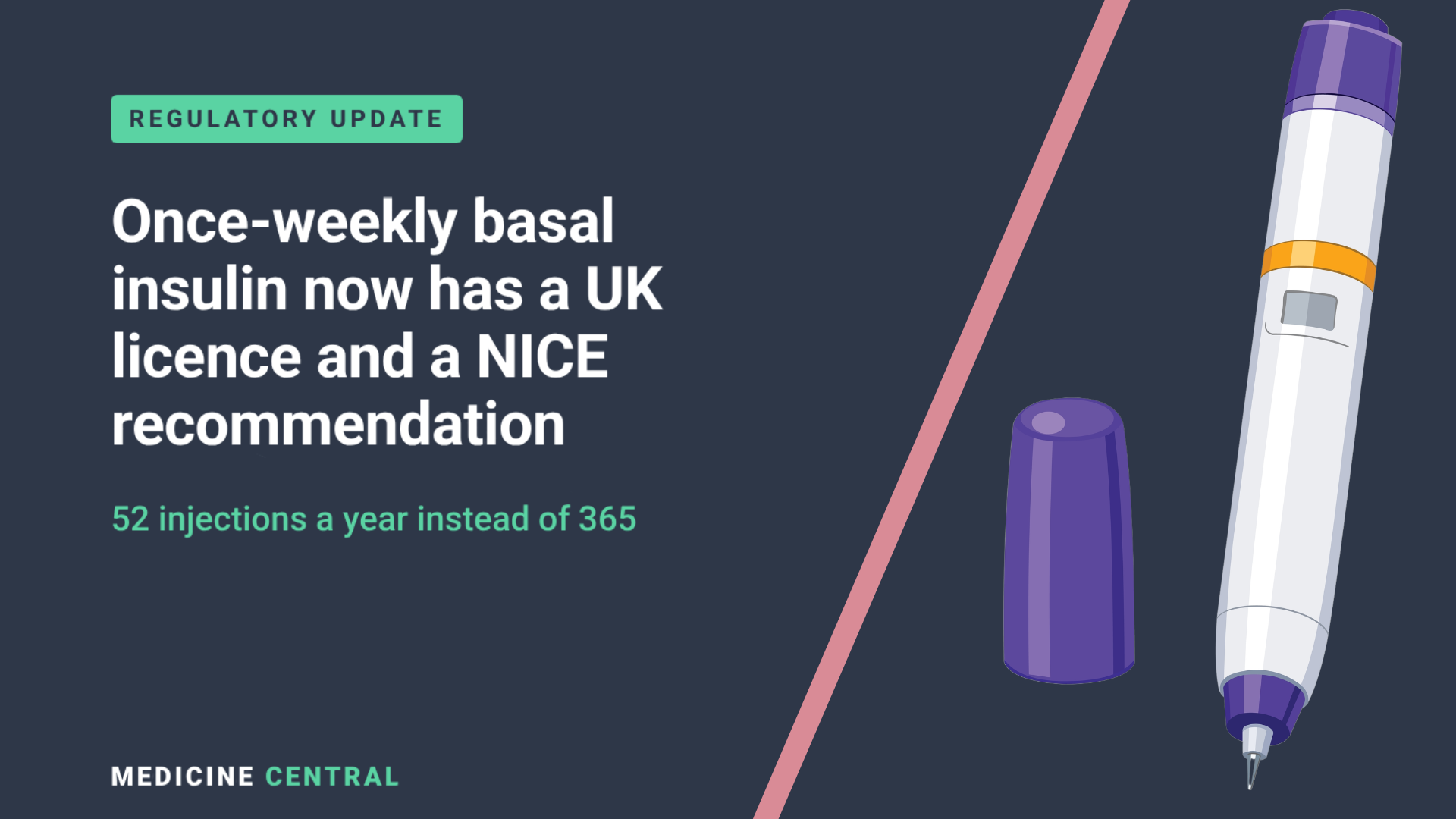
For someone who needs help with every basal insulin dose, this means 52 assisted injections a year instead of 365.
On 13 October 2026, the MHRA authorised insulin efsitora alfa (Onswik) for adults with type 2 diabetes.¹ It is a basal insulin given once a week. Three days later, NICE published technology appraisal guidance TA1200. It recommends efsitora as an option within its licence.²
The MHRA says trials showed blood glucose control comparable to daily basal insulin. Hypoglycaemia was the most common side effect. The full product information will follow on the MHRA products website.¹
The licence rests on four phase 3 trials, QWINT-1 to QWINT-4.⁶ Each compared weekly efsitora with a daily basal insulin. They include:
QWINT-1: about 800 adults new to insulin. Fixed-dose efsitora versus daily insulin glargine U100, over 52 weeks.³
QWINT-3: 986 adults already on basal insulin. Efsitora versus daily insulin degludec. The main result was at 26 weeks.⁴
QWINT-4: 730 adults on basal and mealtime insulin. Efsitora versus daily glargine U100, both with mealtime insulin, over 26 weeks.⁵
In each trial, efsitora lowered HbA1c as well as the daily insulin did. The EMA reports differences between the two arms of −0.01 to −0.09 percentage points.⁶
QWINT-1 also tested a simpler way to dose. Efsitora started at 100 units a week. It then moved up in fixed steps to 150, 250 or 400 units. From week 16, people above their glucose target could switch to flexible dosing.³ In that trial:³
HbA1c fell by 1.19 percentage points with efsitora and 1.16 with glargine. The difference was −0.03 (95% CI −0.18 to 0.12).
Clinically significant or severe hypoglycaemia was about 40% less common with efsitora. There were 0.50 events per patient-year, against 0.88 with glargine.
The weekly dose replaces the basal injection only. People who also use mealtime insulin still need those injections.
What NICE says
Over 26 to 52 weeks, NICE says efsitora works as well as insulin degludec and glargine U100.² Its costs are similar or lower. That assumes people do equally well and some need help to inject. So NICE asks clinicians to choose the least expensive suitable option. The cost includes dose, administration and price.²
NICE says efsitora may particularly help people who need support to take insulin. This includes people who are frail or have a learning disability. It also includes people with problems using their hands, or with visual, cognitive or sensory impairment. It may also suit people who find daily injections hard. One example is people of working age with early-onset type 2 diabetes.²
But these groups were underrepresented in the trials.² The biggest saving in NICE's model was district nurse time. It assumed one hour of a specialist district nurse's time for each assisted injection. NICE says the help people need varies and was not fully explored. That adds uncertainty.²
The NHS in England must fund efsitora within 90 days of the guidance.²
Diabetes UK said any NHS rollout "should be supported by clear guidance, staff training and fair access".⁷
What does this mean in primary care?
A once-weekly basal insulin is now licensed in the UK for adults with type 2 diabetes. NICE recommends it as an option.
In trials, it controlled HbA1c as well as daily basal insulin. NICE does not say it is better. It asks for the least expensive suitable option.
The clearest gain is for people who need a carer, family member or district nurse to give their basal insulin.
These are the people least represented in the trials.
Mealtime insulin does not change. Only the basal dose moves to weekly.
Local formulary decisions will shape when it reaches practices.
Intended for UK healthcare professionals only. This article reports on published clinical data and regulatory guidance and does not constitute prescribing advice.
References
Medicines and Healthcare products Regulatory Agency. MHRA authorises Onswik (insulin efsitora alfa) for adults with type 2 diabetes. 13 October 2026. https://www.gov.uk/government/news/mhra-authorises-onswik-insulin-efsitora-alfa-for-adults-with-type-2-diabetes (accessed October 2026)
National Institute for Health and Care Excellence. Insulin efsitora alfa for treating type 2 diabetes. Technology appraisal guidance TA1200. 16 October 2026. https://www.nice.org.uk/guidance/ta1200 (accessed October 2026)
Rosenstock J, Bailey T, Connery L, et al. Weekly fixed-dose insulin efsitora in type 2 diabetes without previous insulin therapy. N Engl J Med. 2025;393:325–335. doi:10.1056/NEJMoa2502796
Philis-Tsimikas A, Bergenstal RM, Bailey TS, et al. Once-weekly insulin efsitora alfa versus once-daily insulin degludec in adults with type 2 diabetes currently treated with basal insulin (QWINT-3): a phase 3, randomised, non-inferiority trial. Lancet. 2025;405:2279–2289. doi:10.1016/S0140-6736(25)01044-X
Blevins T, Dahl D, Pérez Manghi FC, et al. Once-weekly insulin efsitora alfa versus once-daily insulin glargine U100 in adults with type 2 diabetes treated with basal and prandial insulin (QWINT-4): a phase 3, randomised, non-inferiority trial. Lancet. 2025;405:2290–2301. doi:10.1016/S0140-6736(25)01069-4
European Medicines Agency. Onswik: opinion. 25 June 2026. https://www.ema.europa.eu/en/medicines/human/EPAR/onswik (accessed October 2026)
National Institute for Health and Care Excellence. NICE recommends weekly insulin jab that could cut injections from 365 a year to just 52. Press release, 20 August 2026. https://nice-newsroom.prgloo.com/news/embargoed-nice-recommends-weekly-insulin-jab-that-could-cut-injections-from-365-a-year-to-just-52 (accessed October 2026)