
Lipoprotein(a): The Overlooked Cardiovascular Risk Marker You Should Know About

On-demand CPD: cardiovascular risk in primary care
Watch Prof Ahmet Fuat's on-demand session on assessing cardiovascular risk beyond traditional tools.
Introduction
Cardiovascular disease (CVD) remains one of the leading causes of death globally, despite major advances in prevention and treatment. While traditional risk factors such as LDL cholesterol, smoking, hypertension, and diabetes are well recognised, another important but often under-measured marker is lipoprotein(a), commonly abbreviated as Lp(a). Increasing awareness among clinicians and patients is now placing Lp(a) firmly on the cardiovascular risk map.
Lp(a) is a genetically determined, largely non-modifiable atherothrombotic risk factor with lifetime exposure. Estimates suggest 20% of the UK population have raised Lp(a) levels, rising to 25% in South Asians and 30% in African-derived backgrounds. Large UK Biobank analyses show graded, independent associations between Lp(a) and ASCVD, while European and international consensus statements now recommend once-in-a-lifetime testing in most adults – earlier if family history or premature ASCVD is present. Elevated Lp(a) helps explain ‘residual risk’ and identifies people who may benefit from lower LDL-C targets and earlier therapy.
What is Lipoprotein(a)?
Lipoprotein(a) is a cholesterol-rich particle in the blood that is structurally similar to low-density lipoprotein (LDL), but with an additional protein called apolipoprotein(a) attached. This unique structure gives Lp(a) pro-atherogenic, pro-inflammatory, and pro-thrombotic properties. It is the single biggest genetic determinant of CVD.
Unlike LDL cholesterol, which is heavily influenced by lifestyle, Lp(a) levels are largely genetically determined and remain relatively stable throughout life. This means that diet, exercise, and most lipid-lowering therapies have minimal impact on Lp(a) concentrations.
Elevated Lp(a) contributes to:
Accelerated atherosclerosis
Increased risk of coronary artery disease
Aortic valve stenosis
Stroke
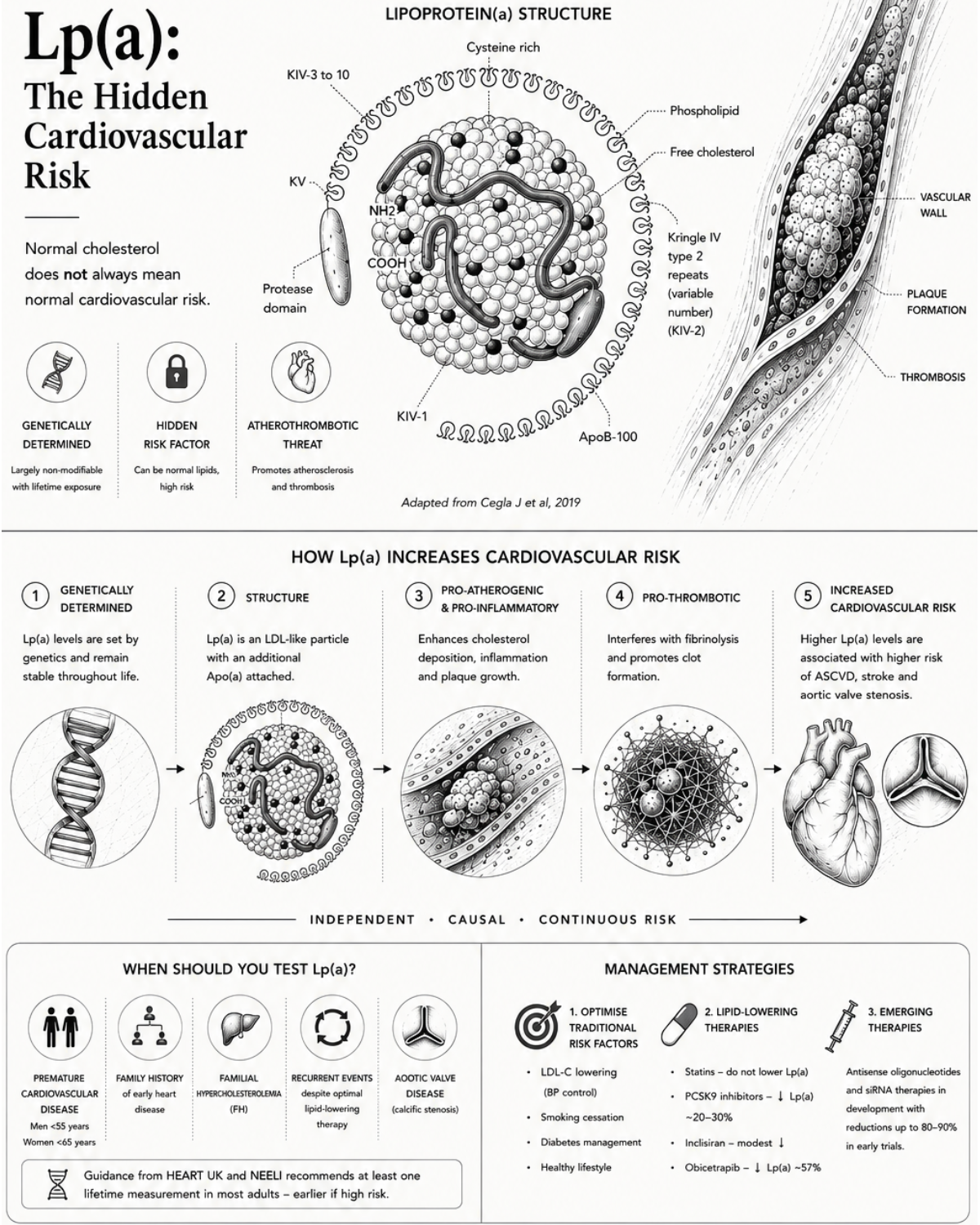
Download the Lp(a) Infographic
Why Lp(a) Matters
A key issue with Lp(a) is that individuals can have completely normal standard lipid profiles, yet still carry significant cardiovascular risk due to high Lp(a). This makes it a “hidden risk factor.”
Large-scale genetic and epidemiological studies have confirmed that elevated Lp(a) is an independent causal risk factor for cardiovascular disease. Importantly, the risk appears continuous - higher levels correlate with higher risk.
When Should Lp(a) Be Measured?
Guidance from organisations such as HEART UK and the NEELI has helped clarify when testing is appropriate.
HEART UK Recommendations
HEART UK recommends that Lp(a) should be measured at least once in a person’s lifetime in certain groups, including:
Individuals with premature cardiovascular disease (men <55 years, women <65 years)
Those with a family history of early heart disease
People with familial hypercholesterolaemia (FH)
Individuals with recurrent cardiovascular events despite optimal lipid-lowering therapy
Those with calcific aortic valve disease
HEART UK increasingly supports broader testing, especially as awareness grows and treatments targeting Lp(a) are being developed.
NEELI Guidance
The NEELI takes a more proactive stance, advocating:
Universal or near-universal screening in adulthood
Early measurement, ideally from adolescence or early adulthood, especially in high-risk families
Integration of Lp(a) into routine cardiovascular risk assessment
NEELI emphasises that, because Lp(a) is genetically determined, a single lifetime measurement is usually sufficient, unless specific clinical circumstances warrant repeat testing.
Understanding Lp(a) Results: Risk Banding
One of the challenges with Lp(a) is interpreting the results, as different laboratories may report values in either nmol/L (preferred) or mg/dL. Risk thresholds vary slightly between guidelines, but broadly align.
Commonly Used Risk Categories (nmol/L)
HEART UK Risk Interpretation
HEART UK broadly categorises:
< 90 nmol/L → Minor added risk
90-200 nmol/L → Moderate risk
200-400 nmol/L → High risk
> 400 nmol/L → Very high risk
NEELI Perspective
The NEELI aligns with international consensus:
Risk begins to rise significantly above ~125 nmol/L
Levels above ~250 nmol/L are considered particularly concerning
Very high levels (>400 nmol/L) may confer risk comparable to FH
Clinical Implications of Elevated Lp(a)
An elevated Lp(a) level should not be viewed in isolation. Instead, it modifies overall cardiovascular risk.
For example:
A person with borderline LDL cholesterol but high Lp(a) may require more aggressive treatment
Patients with established cardiovascular disease and high Lp(a) are at increased risk of recurrence
It may explain “residual risk” in patients already on statins
Management Strategies
1. Optimising Traditional Risk Factors
Since Lp(a) itself is difficult to lower, management focuses on reducing overall cardiovascular risk:
Aggressive LDL cholesterol lowering (e.g., statins, ezetimibe, PCSK9 inhibitors)
Blood pressure control
Smoking cessation
Diabetes management
Healthy lifestyle interventions
2. Lipid-Lowering Therapies
Statins: Do not lower Lp(a), but remain essential for LDL reduction
PCSK9 inhibitors: Can reduce Lp(a) by ~20-30%
Inclisiran: Modest Lp(a) reduction
Obicetrapib: 57% Lp(a) reduction
3. Emerging Therapies
New treatments specifically targeting Lp(a) are in development, including antisense oligonucleotides and small interfering RNA (siRNA) therapies. Early trials show reductions of up to 80-90%, raising hope for targeted risk reduction in the near future.
Practical Takeaways
Lp(a) is a genetically determined, independent cardiovascular risk factor
A single lifetime measurement is usually sufficient
Testing is particularly important in those with premature CVD or family history
Risk increases progressively, especially above 125 nmol/L
Management focuses on aggressive control of modifiable risk factors
Conclusion
Lp(a) is no longer a niche biomarker - it is a clinically significant contributor to cardiovascular risk that deserves wider recognition. Guidance from organisations such as HEART UK and the NEELI highlights the importance of measuring Lp(a), particularly in those at increased risk.
As targeted therapies approach clinical use, identifying individuals with elevated Lp(a) today will be crucial in shaping the prevention strategies of tomorrow. For clinicians and patients alike, understanding Lp(a) represents an important step toward more personalised cardiovascular care.
References:
HEART UK. Lipoprotein(a) guidance and patient resources.
NEELI Initiative publications on Lp(a) screening and risk assessment.
European Atherosclerosis Society Consensus Statement on Lp(a).
NICE guidelines on cardiovascular risk assessment and lipid modification.
Enjoyed this article?
- ✓Unlimited access to clinical evidence articles
- ✓Weekly newsletter with clinical evidence
- ✓Free for registered healthcare professionals