
How much does HPV vaccination reduce cervical cancer mortality?
Does the HPV vaccine reduce deaths from cervical cancer, or does it only help with cancers that screening would have caught anyway?
A national analysis aimed to answer these questions.
It used cervical cancer mortality data for England from 2001 to 2024, drawn from the National Disease Registration Service's open dashboard and ONS sources.¹
Results:
Among women aged 20 to 24 with the highest vaccination coverage (88 to 91%), no deaths from cervical cancer were observed, a reduction of 100% (95% CI 84 to 100).
For women aged 25 to 29, the decline in mortality was 69% from 2020 to 2024 (95% CI 55 to 79%).
These reductions are conservative: around a quarter of the 2010 to 2014 comparison group had been vaccinated, weakening the unvaccinated baseline.
The authors also note that zero deaths in the youngest group likely reflects a very low underlying rate rather than true eradication.
For women aged 30 to 34, fewer than 50% were vaccinated by 2024. Most would have received the vaccine between ages 15 and 18, when they may have already been infected with HPV. This can make the vaccine less effective.
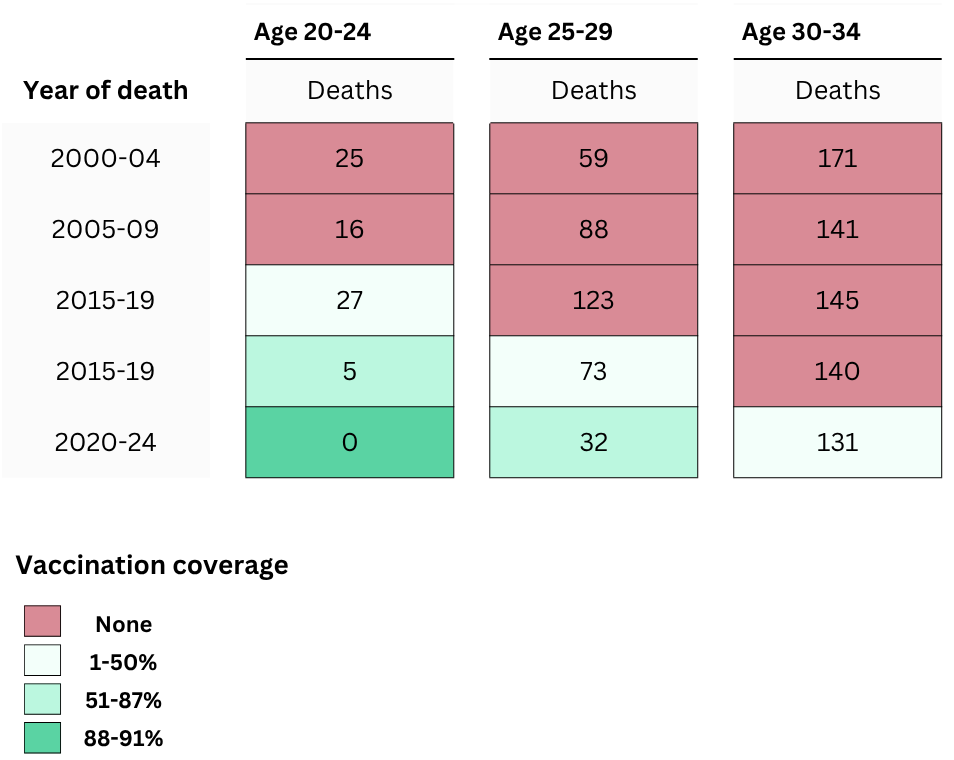
Figure 1. Age-specific mortality counts for 2000–24 by 5-year period of death. Shading indicates HPV vaccination coverage. HPV=human papillomavirus. Adapted from Sasieni and Falcaro, under CC BY 4.0.¹
The effectiveness of vaccination was measured using an estimated relative risk reduction (RRR).
For the 20 to 24 and 25 to 29 vaccinated age groups, the RRRs were estimated to be 100% (95% CI, 81 to 100 (p = 0.0008) and 89 to 100 (p < 0.0001) respectively).
For women aged 30 to 34 the estimate was 63%, but the wide confidence interval (–13 to 100) means the effect in this group is not yet clear, so more research is needed.
In England, the vaccination programme has been linked to about 199.6 fewer cervical cancer deaths across all groups by the end of 2024 (95% CI 125.0 to 274.2).
While it is still too early to determine the exact effect of HPV vaccination on cervical cancer mortality in the 30 to 34 age group, the rest of the data is consistent with the general finding that HPV vaccination substantially reduces cervical cancer mortality. This is especially true for women younger than 65 years, for whom cervical cancer remains the second most common cause of cancer death.
The evidence is observational and ecological, based on population-level coverage instead of individual status, and could not be broken down by ethnicity.
What does this mean for UK primary care?
These findings highlight the life-saving impact of HPV vaccination. They show the importance of vaccinating early, between ages 12 and 15. They also show the markedly reduced efficacy in older cohorts, likely because they may already have been exposed to HPV.
A lingering concern had been that vaccination might only prevent the early-stage cancers screening already catches. However, these findings suggest otherwise. Deaths, not just diagnoses, have decreased as vaccination coverage has increased. Together they support the WHO goal of eliminating cervical cancer as a public health problem, and high vaccine uptake among young adolescents worldwide.
Reference
Sasieni P, Falcaro M. Cervical cancer mortality trends following HPV vaccination in England, 2001–24: an analysis of population-based mortality data. Lancet 2026. https://doi.org/10.1016/S0140-6736(26)00918-9
Medicine Central is a clinical evidence review for UK primary care clinicians. Content reflects evidence current at time of publication and should be read alongside local formulary and clinical guidance. Guest contributors retain responsibility for the accuracy and originality of their work. Views expressed are the author's own and do not necessarily reflect those of Medicine Central. For healthcare professionals only.
Enjoyed this article?
- ✓Unlimited access to clinical evidence articles
- ✓Weekly newsletter with clinical evidence
- ✓Free for registered healthcare professionals