ACHIEVE-5 phase 3 trial shows superiority of GLP-1 RA alongside basal insulin
ACHIEVE-5 is the first phase 3 trial that tests if the once-daily oral GLP-1 RA (orforglipron) can work alongside basal insulin (with no restriction on food or water).
Basal insulin does a lot of the heavy lifting in type 2 diabetes, but it has a ceiling that has little to do with pharmacology. Fear of hypoglycaemia and weight gain often stalls titration before fasting glucose hits target. This leads to overbasalisation: rising doses, unchanged HbA1c, and no better control for the patient.
The ACHIEVE-5 trial:
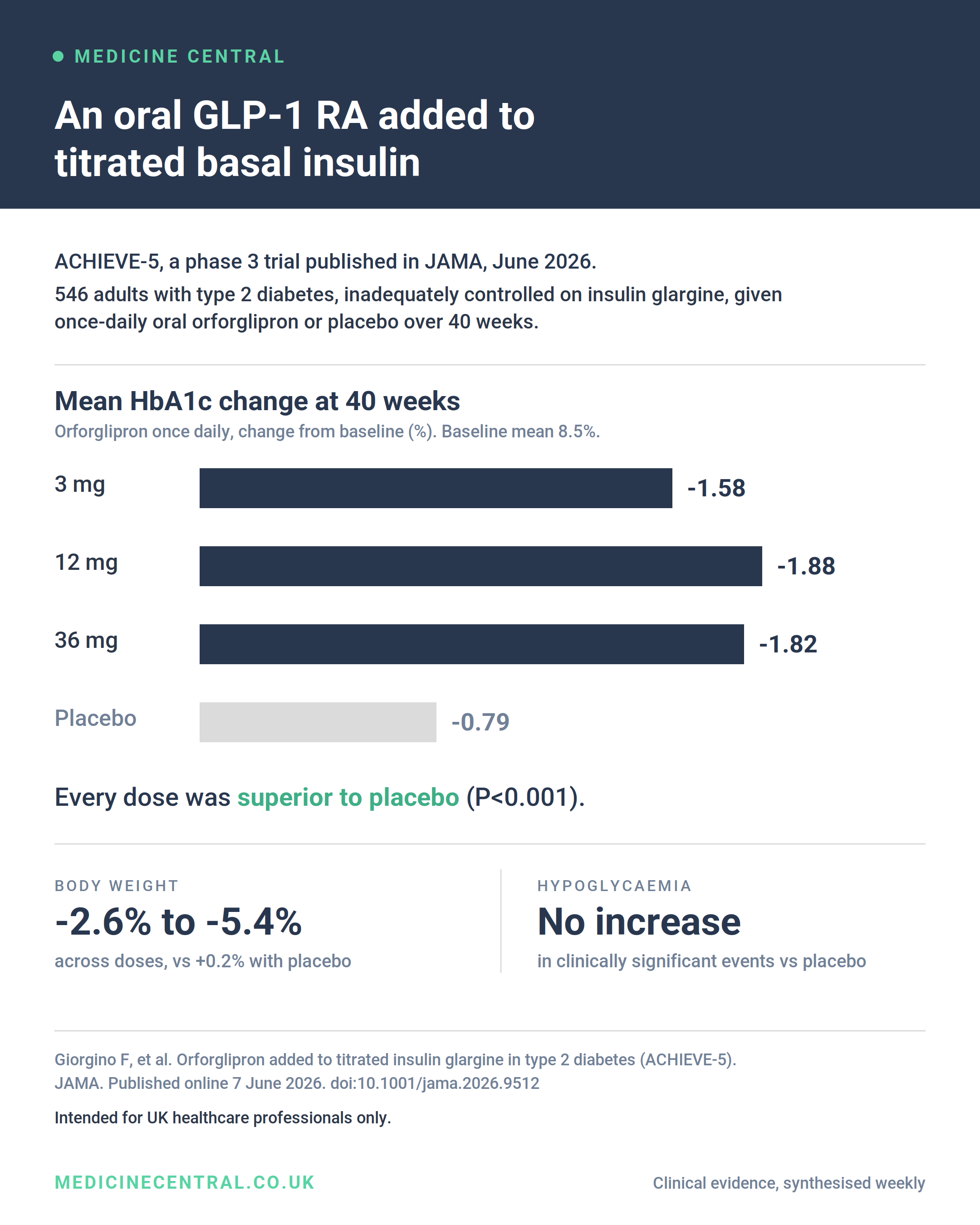
Researchers gave 546 adults, who had poor control on insulin glargine, either orforglipron at 3 mg, 12 mg, or 36 mg, or a placebo. Some participants also took metformin or an SGLT2 inhibitor.
Took place across 72 sites in five countries over 40 weeks.
Baseline HbA1c averaged 8.5%, with a median diabetes duration of around 14 years.
Everyone, including the placebo group, continued to titrate their glargine to hit a fasting target. They used a treat-to-target algorithm. So, the comparison was orforglipron against optimised basal insulin.
Both the 12 and 36 mg doses outperformed placebo. HbA1c dropped by 1.88% with 12 mg and 1.82% with 36 mg, compared to a 0.79% reduction with placebo. This means a difference of about one percentage point (P<0.001 for both).
The 3 mg dose, which was a key secondary endpoint, reduced HbA1c by 1.58% and was also superior to placebo.
The proportion of patients achieving an HbA1c below 7% ranged from 57% to 70% with orforglipron doses. In contrast, only 25% achieved this on placebo. For those reaching 6.5% or lower, the figures were between 43% and 60% for orforglipron, compared to 12% on placebo.
Weight decreased overall, with average drops of 2.6% to 5.4% for the doses. In contrast, the placebo group saw a 0.2% increase, about 2 to 5 kg.
↓ Download the Study Summary (PDF)
Two features stand out for anyone managing insulin in general practice.
The first point is that these glycaemic gains needed less insulin, not more. In the orforglipron groups, glargine doses increased by about 30% to hit the same fasting targets. In contrast, the placebo group saw a rise of 75%.
The second point is hypoglycaemia. Orforglipron helped many participants reach near-normal glucose levels. However, it did not lead to a higher rate of clinically significant hypoglycaemia than placebo. Overall, the rates remained below one event per patient-year.
↓ Download the Study Summary (PDF)
Some caveats AS ALWAYS:
Orforglipron is still under investigation and isn’t licensed in the UK. This points to the future of oral GLP-1 therapy, but it doesn’t change current prescribing practices
The trial lasted 40 weeks. It used a standardised insulin algorithm and fasting targets that might not reflect daily titration
Continuous glucose monitoring was not included
The authors also noted that background insulin adjustment could be a confounding factor
↓ Download the Study Summary (PDF)
References
Cowart K. Overbasalization: addressing hesitancy in treatment intensification beyond basal insulin. Clin Diabetes. 2020;38(3):304-310. doi:10.2337/cd19-0061
Giorgino F, D'Souza S, Ludwig L, et al. Orforglipron added to titrated insulin glargine in type 2 diabetes: the ACHIEVE-5 randomized clinical trial. JAMA. Published online 7 June 2026. doi:10.1001/jama.2026.9512
Rosenstock J, Hsia S, Nevarez Ruiz L, et al. Orforglipron, an oral small-molecule GLP-1 receptor agonist, in early type 2 diabetes. N Engl J Med. 2025;393(11):1065-1076. doi:10.1056/NEJMoa2505669
Enjoyed this article?
- ✓Unlimited access to clinical evidence articles
- ✓Weekly newsletter with clinical evidence
- ✓Free for registered healthcare professionals