
ACHIEVE-4: what the mortality signal actually tells UK clinicians
This week’s headline result is also this week's most over-hyped: 57% lower all-cause mortality with orforglipron compared to insulin glargine, and what these findings actually mean.
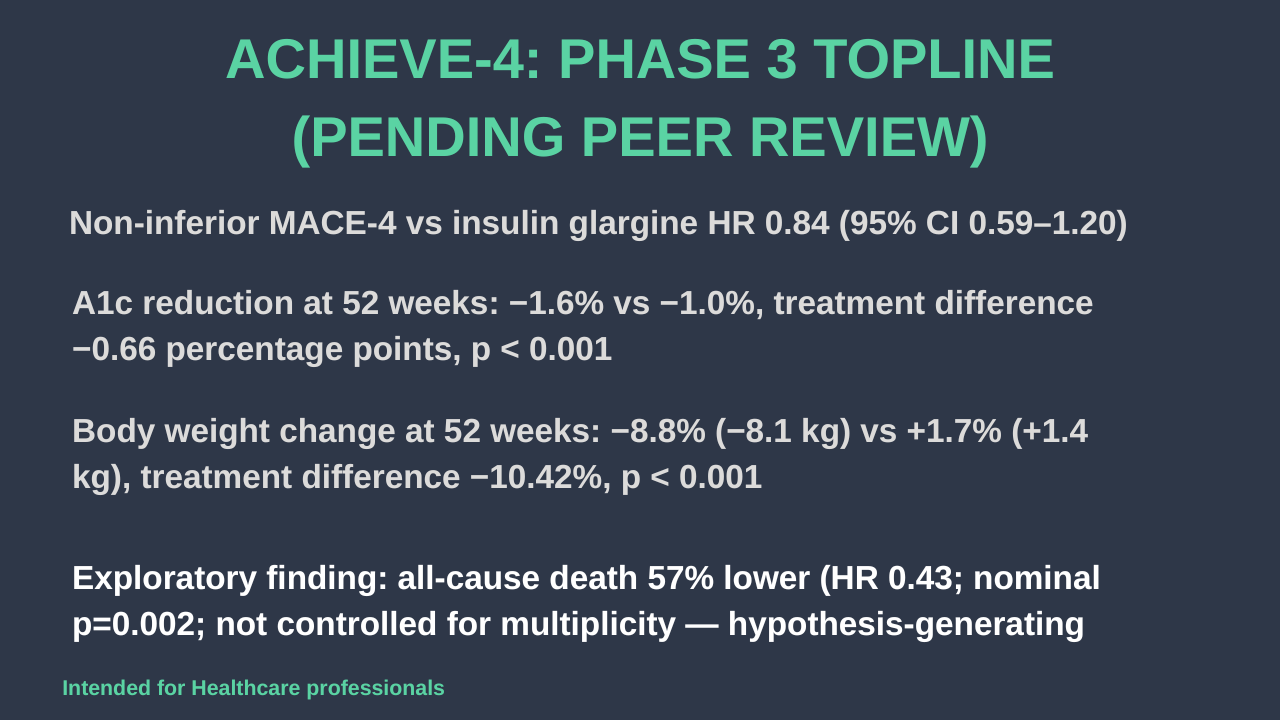
The ACHIEVE-4 topline from Lilly delivered on its primary endpoint. In a study of 2,749 adults with type 2 diabetes and elevated cardiovascular risk, oral orforglipron was non-inferior to insulin glargine. This was measured by major adverse cardiovascular events over a median of 3.1 years. Hazard ratio was 0.84 (95% CI 0.59–1.20). A1c reductions were superior (−1.6% vs −1.0% at 52 weeks), as was weight change (−8.8% vs +1.7%), both persisting to 104 weeks.
The biggest finding was a 57% lower all-cause mortality with orforglipron compared to insulin glargine (HR 0.43, 95% CI 0.25–0.75). It is also the number to handle with most care. This was a pre-planned but non-multiplicity-controlled analysis. It is hypothesis-generating, not confirmatory. Until the full manuscript is peer-reviewed and the methodology can be inspected, it is premature to position orforglipron as a cardioprotective agent; in the way we do for semaglutide after SELECT or tirzepatide after SURPASS-CVOT.
For UK primary care, the clinically relevant story sits elsewhere. Orforglipron is a once-daily, small-molecule, non-peptide GLP-1 receptor agonist. It needs no cold chain, no injection, and no food or water restrictions. If the FDA filing leads to approval in late 2026, followed by MHRA licensing and NICE appraisal, the UK would gain an oral GLP-1 RA. This would bypass much of the supply, storage, and patient-preference issues that currently limit access to injectable therapies. The scalable manufacturing argument matters as much as the efficacy one.
Safety signals in ACHIEVE-4 were consistent with the class. Most common adverse events were gastrointestinal (nausea, vomiting, diarrhoea, constipation, decreased appetite). Discontinuation due to adverse events was 10.6% over the 52-week minimum treatment period, which is in line with existing injectable comparators. No new hepatic safety signals were reported.
Two main factors warrant attention before a UK launch. First, the full peer-reviewed publication will be critical for its mortality analysis methodology and cause-of-death breakdown. Second, NICE must decide how to treat an oral GLP-1 RA while injectable semaglutide and tirzepatide have established cardiovascular and renal outcome data that oral orforglipron currently lacks. Non-inferiority to insulin glargine is not the same as the placebo-controlled superiority trials. These trials are what support the current class positioning in UK practice.
For now, the practical takeaway for clinicians is narrower than the headline suggests. Orforglipron seems to effectively lower glucose and weight. It has a consistent GI side-effect profile and no new cardiovascular safety issues. The mortality signal is interesting and worth watching. It is not yet evidence on which prescribing decisions can rest.
To understand how NICE positions GLP-1 receptor agonists in UK primary care, read our coverage of the GLP-1 revolution. You can also find the broader class safety picture in the MHRA semaglutide vision loss update. Finally, our report on Ozempic for Alzheimer’s illustrates how similar hypothesis-generating signals can collapse in other therapy areas.
References
Eli Lilly and Company. ACHIEVE-4, the longest Phase 3 study of Lilly’s orforglipron to date, reaffirmed its cardiovascular and overall safety profile. Press release, 16 April 2026. Available at: investor.lilly.com
Medicine Central is a clinical evidence review for UK primary care clinicians. Content reflects evidence current at time of publication and should be read alongside local formulary and clinical guidance. Guest contributors retain responsibility for the accuracy and originality of their work. Views expressed are the author's own and do not necessarily reflect those of Medicine Central. For healthcare professionals only.
Enjoyed this article?
- ✓Unlimited access to clinical evidence articles
- ✓Weekly newsletter with clinical evidence
- ✓Free for registered healthcare professionals