
Unseen in primary care: how patients with complex mental health difficulties experience accessing help
Around a quarter of patients presenting to primary care with mental health difficulties meet criteria for personality disorder, yet only 1 to 1.5% have a coded diagnosis. A new qualitative study explores what that gap looks like from the patient side.
Complex mental health difficulties (CMHD) is an umbrella term describing anyone living with multiple sources of distress, often meeting criteria for a diagnosed personality disorder, complex trauma, or persistent depressive conditions. Around a quarter of patients presenting to primary care with mental health difficulties meet criteria for personality disorder, yet only 1 to 1.5% have a coded diagnosis.
This raises the question: how do adults with CMHD describe and understand their difficulties, and how do they experience accessing primary care and other sources of support?
A new qualitative study, part of the wider UNSEEN project, set out to answer exactly that.
Study design
Nineteen participants aged 20 to 79 were recruited via GP practices in areas of relatively high deprivation, all diagnosed with a CMHD, including but not limited to autism, personality disorders, childhood trauma and complex emotional needs. All were White British except one South Asian participant.
A semi-structured interview schedule was developed in collaboration with three people with lived experience of CMHD, and a reflexive thematic analysis was conducted to develop themes from recurring patterns in the interviews.
Results
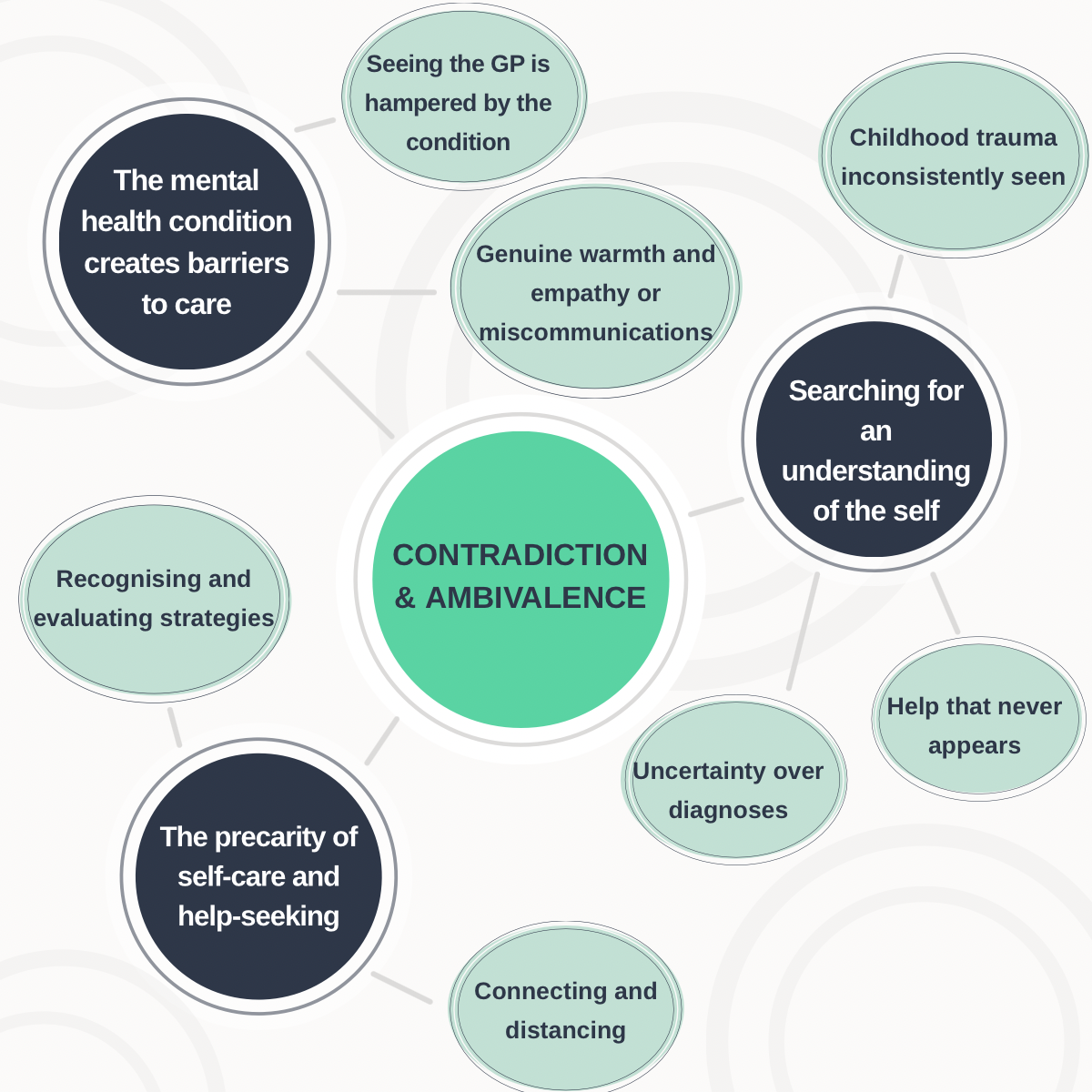
The first theme, searching for an understanding of the self, captured how uncertain participants felt about their diagnoses.
Many described the work of arriving at a diagnosis as something they had carried themselves, and reported that changes or delays left them without the clarity they were looking for as they moved between services. Participants often drew their own connections between early life experiences and their mental health. Where a consultation picked that thread up, it mattered to them. Where it did not, several described feeling that a significant part of their history had gone unrecorded.
Some described care that felt fragmented across providers, with messaging from one service that did not match another, and a few had come to describe themselves as "untreatable" or "unworthy of care".
The second theme showed how the condition itself shapes access.
Shame around their difficulties often delayed help-seeking, and participants found this harder to overcome where access routes were built around brief, acute demand: early morning phone queues, short appointments, and having to re-tell their history each time. Those who struggled to make contact early tended to reach support later, at a point where distress had become visibly severe. One participant described help as something that arrives only after harm has already happened, to themselves or someone else.
Set against this, participants were consistent about what worked. Regular check-ins with a familiar GP were valued for building trust, and continuity of care was described as the foundation for anything genuinely collaborative.
The third theme reflected the precarity of self-care and help-seeking.
Participants moved back and forth between self-reliance and seeking support, while juggling family, work and untreated distress. Many recognised their own coping mechanisms as unhelpful and turned to professional help as a result, but found that the options available did not flex around their circumstances.
Some shielded family from aspects of their distress, while others carefully managed close relationships that could be detrimental to their wellbeing. Supportive partners and friends provided consistency and positive regard, giving participants a sense of safety.
Cutting across all three themes was a pattern of contradiction and ambivalence. Participants held clear ideas about what they needed, while also feeling that the version of them a service could see did not match the one they were living. Where support did not flex to their circumstances, participants described disillusionment and self-doubt, and the same tensions ran through relationships with loved ones, where a wish to share distress sat alongside a fear of burdening them.
What this offers primary care
These are patient accounts, drawn from a small sample in areas of high deprivation, and they describe a pathway under pressure. What they do offer is an unusually specific picture of which elements of a consultation carry weight for this group.
Continuity is the clearest of them, and one of the few features participants named that is shaped largely within the practice rather than by commissioning. Alongside it, participants placed value on their early-life context being acknowledged in the room, and on diagnostic uncertainty being named openly rather than left to them to interpret when a label changed.
For some, a recognised diagnosis mattered as a way of understanding themselves and their place in the world. For others, the label itself was less important than the sense that someone had taken the time to understand them as a whole person.
The study also points to access design as a variable that practices can influence. Participants described short appointments and re-telling their history as barriers that the condition itself made harder to overcome. Where practices had found ways to reduce those friction points, the difference was felt.
Reference
Instone R, Achinanya A, Burton C, et al. Experiences of people with complex mental health difficulties accessing help from primary care services: a qualitative interview study. BMC Prim Care 2026;27:246. doi:10.1186/s12875-026-03322-5
Enjoyed this article?
- ✓Unlimited access to clinical evidence articles
- ✓Weekly newsletter with clinical evidence
- ✓Free for registered healthcare professionals