
One patient, three pains: a palliative care case study in opioid titration
On-demand CPD: managing pain in palliative care
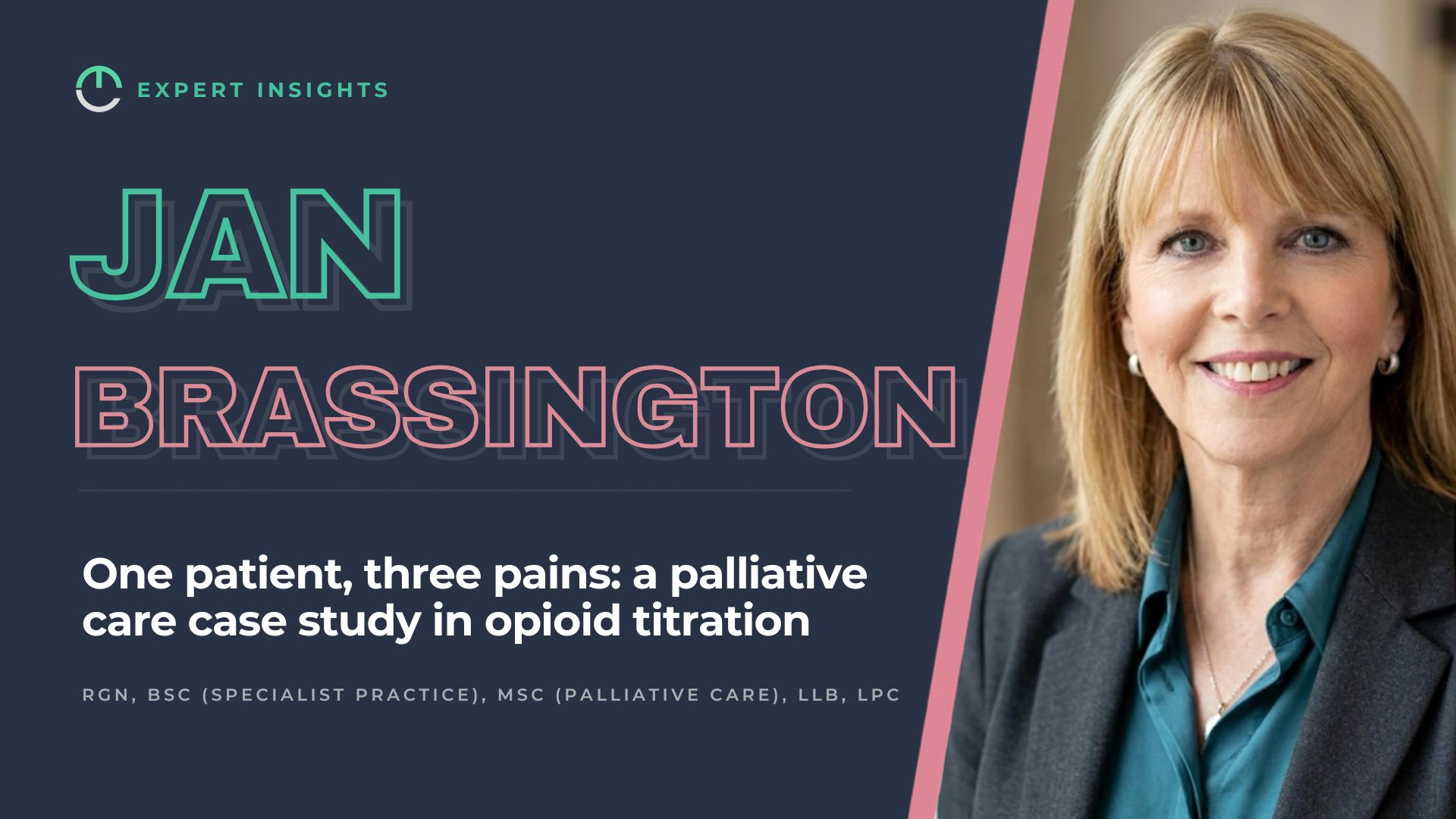
Watch Jan Brassington's on-demand session on managing pain in palliative care, including strong opioids, syringe drivers and non-pharmacological approaches.
This week, our expert insights will guide you through a case study from Jan Brassington’s webinar, ‘Managing Pain in Palliative Care.’ You can now watch it as an on-demand video on our CPD Webinars page!
Patient background:
A 64-year-old man with metastatic prostate cancer is presented to us. He has continuous pain in his right hip. Even under a maximum dose of co-codamol, his pain has not been relieved. Weak opiates are no longer effective – so, what next?
Treatment:
He starts on 15 mg of MST twice daily, with the dose increasing to 60 mg over the following eight weeks. He sees improvements in pain, but there are still times of day when his pain is severe – how do we move forward?
The first step is to make sure his breakthrough analgesia matches his new baseline.
Along with regular slow-release morphine, immediate-release morphine should be given for breakthrough pain.
It should be dosed at one-sixth of the total 24-hour opioid dose.
For 60 mg of MST taken twice daily, once in the morning and once at night, that equals one-sixth of 120 mg.
This means you can use 20 mg of Oramorph as needed.
Re-assessing his pain:
Our patient’s pain is now under control. The daily number of breakthrough doses usually ranges from one to four 20 mg doses of Oramorph.
However, despite the massive improvements, it comes at the cost of significant daytime drowsiness. This is when switching between strong opioids should be considered.
Third line treatment:
Our patient is currently on morphine. Our alternatives are:
Fentanyl - which comes as a patch and is reserved for stable pain, (which rules it out here)
Buprenorphine - a partial agonist, taken in patches.
oxycodone - which is often switched to from morphine, and it is twice as strong as oral morphine.
Weighing these options, we land on oxycodone: oxycodone modified-release (Oxycontin) 30 mg twice daily and immediate-release oxycodone (Oxynorm) 5 mg as needed.
Development of neuropathic pain:
For two months, our patient is less sleepy and his pain is stable. He starts to feel a burning pain in his right hip that goes down to his foot. He describes it as feeling like "walking with a pebble in my shoe." This suggests a neuropathic issue, prompting the scheduling of an MRI scan.
The MRI shows nerve root compression.
This needs radiotherapy to the lumbar sacral area and a course of steroids.
Oxycontin is increased to 60 mg twice daily.
Oxynorm is set at 20 mg as needed.
Additionally, 600 mg of gabapentin will be taken four times daily.
As a result, neuropathic pain is controlled, but a dull ache in the right hip persists and worsens with walking.
A multi-modal approach:
Persistent symptoms like these require a multi-modal approach to treating bone pain.
We have four options:
Strong opioids, which provide baseline pain relief.
NSAIDs, great for inflammatory bone pain, but they need monitoring of GI and renal function.
Radiotherapy, effective for localised bone metastases.
Bisphosphonates, which help reduce skeletal events in metastatic disease.
Bisphosphonates play two key roles: they help manage bone pain by reducing skeletal-related events and the need for pain relief in metastatic bone disease, and they are the first-line treatment for hypercalcaemia of malignancy, used together with hydration. Although this class is a viable option, renal function should be considered before and during treatment, as side effects of treatment include hypocalcaemia, renal failure, arthralgia, myalgia and osteonecrosis of the jaw.
After taking a multi-modal approach to managing our patient’s pain, using opioids, a neuropathic agent and a bone-targeted therapy, we see real functional improvement – and our patient’s walking has improved.
Conclusion:
This case is a reminder that escalating a single agent is rarely the whole answer.
Three different pains required three different responses:
Switch to an opioid if side effects outweighed benefits
Use a neuropathic agent if the pain changed
Apply bone-targeted therapy for further changes.
If your analgesia isn't working, the first question is not ‘how much more?’ but rather ‘what kind of pain is this now?’
Jan's full webinar, including the syringe pump conversions and breakthrough pain management not covered here, is now available on-demand.
Medicine Central is a clinical evidence review for UK primary care clinicians. Content reflects evidence current at time of publication and should be read alongside local formulary and clinical guidance. Guest contributors retain responsibility for the accuracy and originality of their work. Views expressed are the author's own and do not necessarily reflect those of Medicine Central. For healthcare professionals only.
Enjoyed this article?
- ✓Unlimited access to clinical evidence articles
- ✓Weekly newsletter with clinical evidence
- ✓Free for registered healthcare professionals