
MART versus conventional ICS/LABA plus SABA: does switching actually change outcomes?
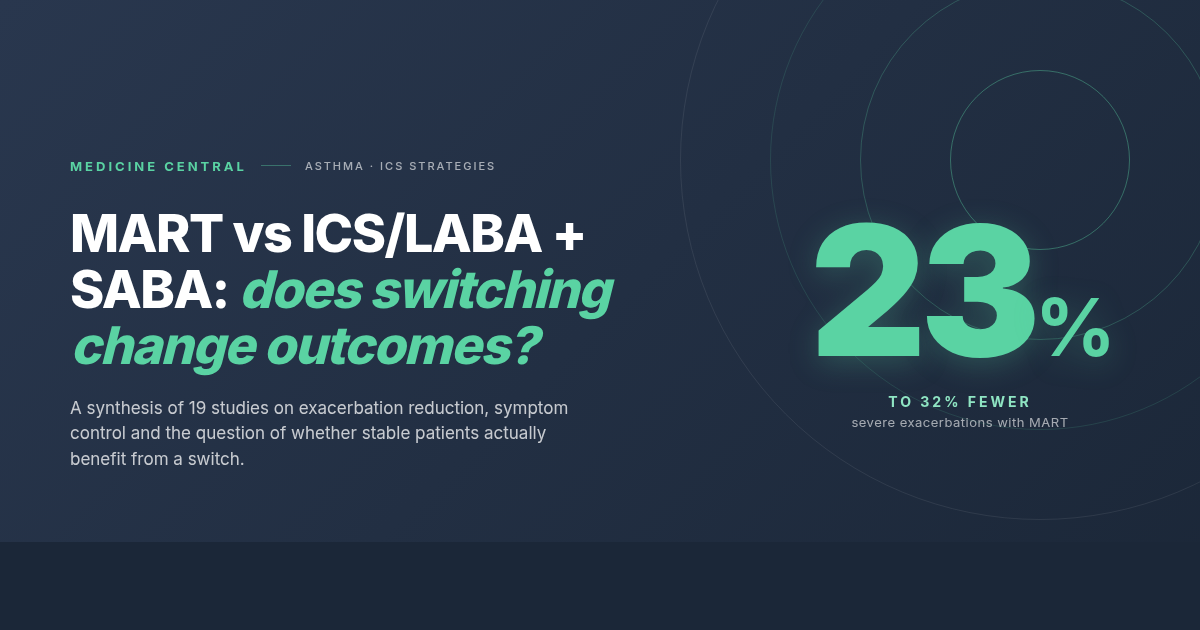
Across 19 papers published since 2022, a consistent picture emerges on MART versus conventional ICS/LABA plus SABA. The headline benefit is concentrated in exacerbation prevention - but the size of the gain depends heavily on baseline exacerbation risk.
We wanted to know the answer to this clinical question (and how that impacts primary care clinicians): What is the real-world effectiveness difference between ICS-formoterol maintenance and reliever therapy (MART) and conventional ICS/LABA plus SABA? In addition, does the difference matter at the patient level, particularly for those already stable on a fixed-dose ICS/LABA such as fluticasone/salmeterol?
Across 19 papers published since 2022, including multiple meta-analyses, network meta-analyses, RCT post-hoc analyses, real-world cohort studies and cost-effectiveness modelling, a consistent picture emerges. The headline benefit of MART is concentrated in exacerbation prevention.
Symptom control, lung function and quality of life look broadly similar between strategies.
The size of the incremental gain depends heavily on baseline exacerbation risk, which is the variable worth weighing when considering a switch.
The bottom line: MART reduces severe exacerbations by roughly 23 to 32% compared with equivalent or higher-dose ICS/LABA plus SABA, with relative risks around 0.68 to 0.77 and an NNT of around 18 per year in mild asthma to prevent one severe exacerbation. Day-to-day symptom control and lung function are broadly similar, with mean differences well below the minimal clinically important difference. The benefit is most pronounced in patients at higher exacerbation risk; for those already well-controlled on conventional ICS/LABA, incremental gains are modest and concentrated on rare event prevention. Real-world advantages can be blunted by off-guideline SABA co-prescription.
Exacerbation reduction is the strongest signal
The most reproducible finding across the recent evidence base is that MART reduces severe asthma exacerbations by approximately 23 to 32% versus equivalent or higher-dose ICS/LABA plus SABA, with relative risks in the range of 0.68 to 0.77.1–5 This effect has been observed in pooled trial analyses, network meta-analyses comparing single, dual and triple ICS strategies, and across moderate-to-severe populations. Notably, the reduction is seen even when the total daily ICS dose delivered through MART is lower than the comparator regimen, suggesting the as-needed ICS-formoterol component delivers anti-inflammatory exposure at moments of escalating airway inflammation that fixed-dose regimens miss.1,4
Translated into clinical terms, the absolute risk reduction is meaningful. An NNT of around 18 per year to prevent one severe exacerbation in mild asthma sits well within the range considered useful for chronic disease prevention strategies.6 The benefit appears robust across phenotypes commonly seen in primary care, with network meta-analyses showing no significant effect modification by age, BMI, baseline lung function or asthma control status in adult populations.11,12
Symptoms and lung function: less to choose between
If exacerbations are where MART wins, symptoms and lung function are where the two strategies look broadly equivalent. Post-hoc analyses of pooled RCT data and network meta-analyses of quality-of-life outcomes show mean differences in ACQ-5 of around 0.12, well below the minimal clinically important difference of 0.5.7–9 Lung function gains are similarly comparable. The European Respiratory Society's short guidelines on as-needed ICS/formoterol in mild asthma reflect this evidence pattern: the regimen is endorsed for its exacerbation benefit rather than for measurable advantages in day-to-day control.10
This matters when counselling patients. A switch to MART is unlikely to be associated with patients feeling noticeably better on a day-to-day basis. The conversation is better framed around future risk reduction than current symptom relief.
The stable Seretide-equivalent patient: the most clinically relevant question
For patients already well-controlled on conventional ICS/LABA, the evidence base is more nuanced. Post-hoc analyses of MART trials specifically examining stable, well-controlled cohorts show that switching offers modest additional protection against exacerbations but little change in symptoms or quality of life.7,9 In other words, the incremental benefit narrows considerably in patients who are already doing well. The exacerbation reduction effect does not disappear, but it operates against a lower baseline event rate, so the absolute number of exacerbations prevented per patient per year falls.
This is the most clinically relevant subgroup question for UK primary care, where many patients sit on long-standing fixed-dose ICS/LABA regimens without recent exacerbations. The decision to switch is reasonably framed as: is this patient's residual exacerbation risk high enough that a 23 to 32% relative reduction translates into a meaningful absolute benefit, given their preference and inhaler technique?
Real-world adherence patterns can blunt the advantage
Trial efficacy and real-world effectiveness diverge in informative ways. Observational data confirm reduced exacerbation rates and lower oral corticosteroid burden with MART versus non-MART regimens,15 but real-world studies also document frequent co-prescription of SABA alongside MART, contrary to guideline intent.16,17 Patients prescribed a separate SABA inhaler may default to it for relief, bypassing the anti-inflammatory effect that defines MART's mechanism. Survey data from the APPaRENT 2 study highlight gaps between physician and patient perspectives on asthma burden and management that contribute to these prescribing patterns.17
The implication for practice is that MART is not just a prescription change. It requires clear patient education on stopping SABA use, recognising symptom escalation as a trigger for extra ICS-formoterol doses, and reviewing whether legacy SABA prescriptions need to be removed from the repeat record.
Cost-effectiveness and the paediatric gap
Cost-utility analyses generally favour MART, driven by reduced healthcare utilisation from fewer exacerbations rather than by drug acquisition cost differences.18,19 Modelling from multiple health system perspectives consistently finds the strategy economically attractive at standard willingness-to-pay thresholds.
Paediatric evidence remains the clearest gap. Few trials have included children under 12, and ongoing studies including the START CARE protocol aim to address this directly.13,14 Until those data report, extrapolation from adult evidence should be made cautiously and individualised to the child's risk profile.
Putting it together
The evidence supports a stratified rather than blanket approach. For patients with recurrent exacerbations, oral corticosteroid courses or unscheduled care contacts, the case for MART is strong and aligns with the direction of major asthma guidelines.10 For stable patients on conventional ICS/LABA with no recent exacerbations, the incremental benefit is real but smaller, and the switch is best framed as future risk reduction rather than symptom improvement. In all cases, the implementation detail matters as much as the prescription: removing the SABA, confirming inhaler technique and discussing the as-needed dosing principle determine whether the trial-level effect translates into real-world benefit. These are observational and trial-derived associations, not deterministic outcomes; individual response varies and clinical judgement, patient preference and adherence remain central to the decision.
References
Beasley R, Noble J, Weatherall M. The evidence base for ICS/formoterol maintenance and reliever therapy in severe asthma. Eur Respir J. 2024;63. doi: 10.1183/13993003.00523-2024
Beasley R, Bruce P, Hatter L. ICS/formoterol maintenance and reliever therapy: how far beyond asthma? Thorax. 2023;78:430-431. doi: 10.1136/thorax-2022-219979
Beasley R, Harrison T, Peterson S, et al. Evaluation of budesonide-formoterol for maintenance and reliever therapy among patients with poorly controlled asthma. JAMA Netw Open. 2022;5. doi: 10.1001/jamanetworkopen.2022.0615
Mortimer K, Reddel HK, Pitrez PM, Bateman ED. Asthma management in low and middle income countries: case for change. Eur Respir J. 2022;60. doi: 10.1183/13993003.03179-2021
Yamasaki A, Tomita K, Inui G, Okazaki R, Harada T. Differences in the effectiveness of single, dual, and triple inhaled corticosteroid therapy for reducing future risk of severe asthma exacerbation: a systematic review and network meta-analysis. Heliyon. 2024;10. doi: 10.1016/j.heliyon.2024.e31186
Krings JG, Beasley R. The role of ICS-containing rescue therapy versus SABA alone in asthma management today. J Allergy Clin Immunol Pract. 2024. doi: 10.1016/j.jaip.2024.01.011
Hatter L, Houghton C, Bruce P, et al. Asthma control with ICS-formoterol reliever versus maintenance ICS and SABA reliever therapy: a post hoc analysis of two randomised controlled trials. BMJ Open Respir Res. 2022;9. doi: 10.1136/bmjresp-2022-001271
Di Cicco M, Peroni D, Marseglia G, Licari A. Unveiling the complexities of pediatric asthma treatment: evidence, controversies, and emerging approaches. Paediatr Drugs. 2025;27:393-404. doi: 10.1007/s40272-025-00694-6
Maneechotesuwan K, Singh D, Fritscher LG, et al. Impact of inhaled fluticasone propionate/salmeterol on health-related quality of life in asthma: a network meta-analysis. Respir Med. 2022;203:106993. doi: 10.1016/j.rmed.2022.106993
Papi A, Ferreira DS, Agache I, et al. European Respiratory Society short guidelines for the use of as-needed ICS/formoterol in mild asthma. Eur Respir J. 2023;62. doi: 10.1183/13993003.00047-2023
Yorgancioglu A, Cruz AA, Garcia G, et al. A network meta-analysis of the association between patient traits and response to regular dosing with ICS/long-acting beta2-agonist plus short-acting beta2 agonist reliever or maintenance and reliever therapy for asthma. Respir Med. 2023:107377. doi: 10.1016/j.rmed.2023.107377
Roche N, Yorgancioglu A, Cruz AA, et al. Systematic literature review of traits and outcomes reported in randomised controlled trials of asthma with regular dosing of inhaled corticosteroids with short-acting beta2-agonist reliever, as-needed ICS/formoterol, or ICS/formoterol maintenance and reliever therapy. Respir Med. 2023:107478. doi: 10.1016/j.rmed.2023.107478
Barry T, Holliday M, Sparks J, et al. START CARE: a protocol for a randomised controlled trial of step-wise budesonide-formoterol reliever-based treatment in children. ERJ Open Res. 2024;10. doi: 10.1183/23120541.00897-2023
Lomonaco C, Dunn C. Budesonide/formoterol maintenance and reliever therapy in childhood asthma: real-world effectiveness and economic assessment. Pediatrics. 2024;154 Suppl 4:S50. doi: 10.1542/peds.2024-069114mc
Kim C, Lee Y, Lee E, et al. Effectiveness of maintenance and reliever therapy using inhaled corticosteroid-formoterol in asthmatics. J Allergy Clin Immunol Pract. 2022. doi: 10.1016/j.jaip.2022.06.009
Zhang S, Czira A, Harley J, Rothnie KJ, Lee LK, Small M. Burden of illness among patients with asthma prescribed inhaled corticosteroids/long-acting beta2-agonists. NPJ Prim Care Respir Med. 2025;35. doi: 10.1038/s41533-024-00402-w
Chapman KR, Canonica GW, Lavoie KL, et al. Patients' and physicians' perspectives on the burden and management of asthma: results from the APPaRENT 2 study. Respir Med. 2022;201:106948. doi: 10.1016/j.rmed.2022.106948
Zhou K, Zhang M, Zuo C, Xie X, et al. Cost-effectiveness analysis of budesonide/formoterol SMART therapy versus salmeterol/fluticasone plus as-needed SABA among patients 12 years with moderate asthma from the Chinese societal perspective. J Med Econ. 2024;27:1018-1026. doi: 10.1080/13696998.2024.2385191
Rodriguez-Martinez CE, Sossa-Briceno MP, Castro-Rodriguez JA. A cost-utility analysis of single maintenance and reliever (SMART) therapy as compared to step 3 fixed-dose therapy in patients aged 12 years or more with uncontrolled asthma. Pediatr Pulmonol. 2024;60. doi: 10.1002/ppul.27328
Medicine Central is a clinical evidence review for UK primary care clinicians. Content reflects evidence current at time of publication and should be read alongside local formulary and clinical guidance. Guest contributors retain responsibility for the accuracy and originality of their work. Views expressed are the author's own and do not necessarily reflect those of Medicine Central. For healthcare professionals only.
Enjoyed this article?
- ✓Unlimited access to clinical evidence articles
- ✓Weekly newsletter with clinical evidence
- ✓Free for registered healthcare professionals