
Appraising the Longevity Supplement Stack with the Latest Evidence
Patients are arriving in clinic with curated supplement stacks, convinced that longevity science has delivered a shortcut to a longer, healthier life. The evidence tells a more sobering story.
Patients are arriving in clinic with curated supplement stacks, convinced that longevity science has delivered a shortcut to a longer, healthier life. The evidence tells a more sobering story. Before recommending, or simply tolerating, a supplement regimen, clinicians owe it to their patients to ask what the data support.
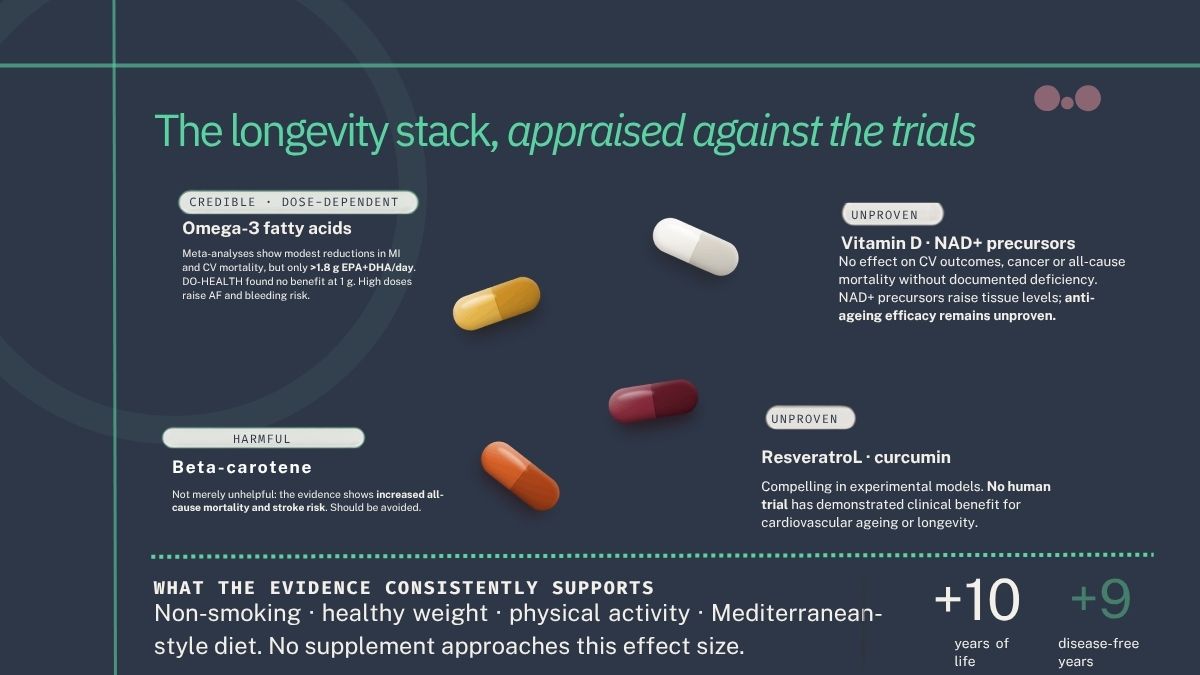
The most clinically credible candidate remains omega-3 fatty acids. Meta-analyses of cardiovascular trials show consistent, if modest, reductions in myocardial infarction and cardiovascular mortality at higher doses, broadly above 1.8 g of EPA plus DHA per day. 1,2 Yet the well-designed DO-HEALTH trial, which followed over two thousand adults aged 70 and above for three years, found that 1 g per day produced no meaningful benefit on blood pressure, cognition, physical performance, or fracture risk. 3 Dose matters, and most over-the-counter products fall short of the threshold where benefit has been demonstrated. High-dose preparations carry their own risks, including an increased incidence of atrial fibrillation and a small but real increase in bleeding tendency, which is particularly relevant in patients already on anticoagulants. 4
Folic acid has modest evidence for stroke prevention in those with inadequate dietary intake or elevated homocysteine, and coenzyme Q10 has shown benefit in heart failure specifically, though neither finding extends to healthy adults pursuing longevity. 1,2 Vitamin D remains one of the most prescribed supplements in primary care, yet repeated large trials and systematic reviews have found no benefit on cardiovascular outcomes, cancer incidence, or all-cause mortality in adults without documented deficiency. 3,5 Beta-carotene is not merely unhelpful; the evidence shows it increases mortality and stroke risk, and should be avoided. 1,2
NAD+ precursors attract considerable interest in longevity medicine. They reliably raise NAD+ levels in blood and tissues, but a 2026 systematic review concluded that clinical effectiveness for meaningful anti-ageing outcomes remains unproven. 6 A meta-analysis of randomised trials found no significant effect on glucose, insulin, or lipid profiles. 7 Polyphenols including resveratrol and curcumin show compelling activity in experimental models, but no human trial has demonstrated clinical benefit for cardiovascular ageing or longevity to date. 8
What does work is less commercially appealing. Large prospective studies consistently show that combinations of healthy behaviours — maintaining a healthy weight, not smoking, staying physically active, and eating well — are associated with more than a decade of additional life expectancy and roughly nine additional disease-free years. 9,10 No supplement approaches that effect size. Whole dietary patterns, particularly Mediterranean and similar plant-forward approaches, outperform isolated supplementation by a substantial margin. 11
For clinicians, the practical message is straightforward. Omega-3 fatty acids at adequate doses have a reasonable evidence base for selected patients with cardiovascular risk. Supplementation should otherwise be guided by documented deficiency or specific clinical indication, not by longevity aspiration. Supplement use should be proactively discussed at every consultation, particularly in older patients on multiple medications, where interactions are common and often undisclosed. 12 Supplements may have a role as adjuncts, but they are no substitute for the lifestyle foundations that the evidence consistently supports.
Download PDF guide: 📎
Longevity_Supplements_1pager.pdf
Download
References
An P, Wan S, Luo Y, et al. Micronutrient Supplementation to Reduce Cardiovascular Risk. J Am Coll Cardiol. 2022;80(24):2269-2285. doi:10.1016/j.jacc.2022.09.048
Khan SU, Khan MU, Riaz H, et al. Effects of Nutritional Supplements and Dietary Interventions on Cardiovascular Outcomes. Ann Intern Med. 2019;171(3):190-198. doi:10.7326/m19-0341
Bischoff-Ferrari HA, et al. DO-HEALTH Randomized Clinical Trial. JAMA. 2020;324(18):1855-1868. doi:10.1001/jama.2020.16909
Chang JP, et al. Safety of Omega-3 Supplementation. Adv Nutr. 2023;14(6):1326-1336. doi:10.1016/j.advnut.2023.08.003
O'Connor EA, et al. Vitamin and Mineral Supplements for Primary Prevention. JAMA. 2022;327(23):2334-2347. doi:10.1001/jama.2021.15650
Gallagher C, Emmanuel OO. NAD⁺ supplementation for anti-aging. Ageing Res Rev. 2026;116:103057. doi:10.1016/j.arr.2026.103057
Chen F, et al. Effects of Nicotinamide Mononucleotide on Glucose and Lipid Metabolism. Curr Diab Rep. 2024;25(1):4. doi:10.1007/s11892-024-01557-z
Zanders L, et al. Cellular Senescence, Inflammaging and Cardiovascular Disease. Immunol Rev. 2026;337(1):e70084. doi:10.1111/imr.70084
Li Y, et al. Impact of Healthy Lifestyle Factors on Life Expectancies. Circulation. 2018;138(4):345-355. doi:10.1161/circulationaha.117.032047
Nyberg ST, et al. Association of Healthy Lifestyle With Years Lived Without Major Chronic Diseases. JAMA Intern Med. 2020;180(5):760-768. doi:10.1001/jamainternmed.2020.0618
Ekmekcioglu C. Nutrition and longevity. Crit Rev Food Sci Nutr. 2020;60(18):3063-3082. doi:10.1080/10408398.2019.1676698
Ronis MJJ, et al. Adverse Effects of Nutraceuticals and Dietary Supplements. Annu Rev Pharmacol Toxicol. 2018;58:583-601. doi:10.1146/annurev-pharmtox-010617-052844
Enjoyed this article?
- ✓Unlimited access to clinical evidence articles
- ✓Weekly newsletter with clinical evidence
- ✓Free for registered healthcare professionals