
GLP-1 receptor agonists vs bariatric surgery, what the evidence actually shows.
Surgery still outperforms pharmacotherapy for sustained weight loss. The gap widens once therapy stops. A practical synthesis for UK primary care prescribers.
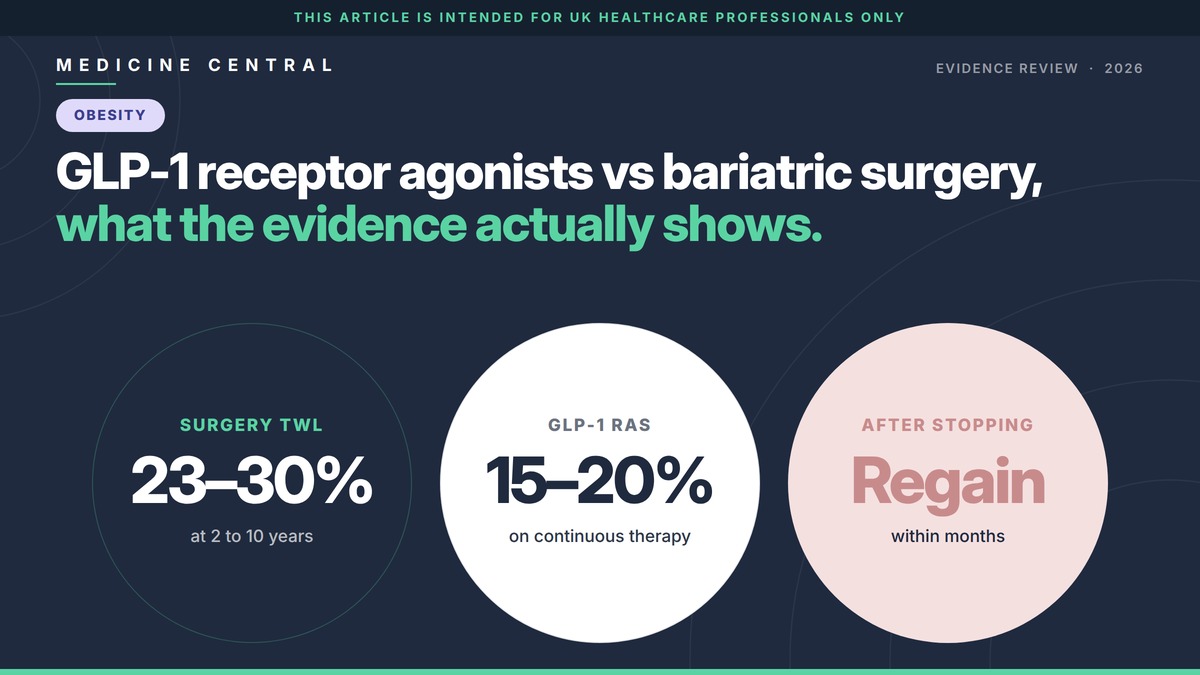
Bariatric surgery achieves greater total weight loss than GLP-1 receptor agonists, and the gap widens over time. Sleeve gastrectomy and gastric bypass produce average total weight loss of 23 to 30% at two to ten years.1–4 GLP-1 receptor agonists reach 15 to 20% at peak effect, but only during active, continuous therapy.2,5,6 Meta-analyses report a mean difference of 11 to 25 kg in favour of surgery.1,7,8 Newer dual receptor agonists have narrowed the gap, but do not match surgical results on average.5,6,9 Surgical weight loss is sustained over years to decades, with most patients maintaining more than 10% TWL long term.2,10 GLP-1 receptor agonists tell a different story. Most patients regain a substantial proportion within months of stopping therapy, regardless of lifestyle support.11,12 The benefits of GLP-1 receptor agonists depend on continuous, potentially lifelong use. Both still improve glycaemic control, blood pressure, and lipids, even where weight loss falls short.5,6
Bariatric surgery carries perioperative risks, low in experienced centres, and long-term nutritional deficiencies that need monitoring; the trade-off is lower ongoing medication dependence.3 GLP-1 receptor agonists are associated with gastrointestinal side effects, most commonly nausea and vomiting; rare but serious events include pancreatitis.5,11 High discontinuation rates due to tolerability and cost are a significant real-world limitation.5,11 Surgery costs more upfront but is more cost-effective long term, as durable weight loss reduces ongoing medication and healthcare contacts.2,4,13 GLP-1 receptor agonist therapy carries high ongoing pharmacy costs, with insurance and NHS coverage for obesity indications variable and often limited.2,13
Researchers are exploring GLP-1 receptor agonists as an add-on to bariatric surgery for patients with suboptimal surgical weight loss or weight regain.14,15,16 Early reviews suggest additional weight reduction and metabolic benefit, but optimal sequencing, patient selection, and long-term outcomes need further study.14,15
{ "headers": ["Outcome", "Bariatric Surgery", "GLP-1 Receptor Agonists"], "rows": [ ["Total weight loss (peak)", "23 to 30%", "15 to 20%"], ["Sustained at 5+ years", "Yes, >10% TWL in most patients", "Only with continuous therapy"], ["Effect of stopping", "N/A (permanent anatomical change)", "Substantial regain within months"], ["Long-term cost-effectiveness", "More cost-effective", "High ongoing pharmacy costs"], ["Key safety considerations", "Perioperative risk, nutritional deficiencies", "GI side effects, rare pancreatitis"], ["Requires lifelong adherence", "No (but nutritional monitoring)", "Yes"] ] } 1. Sarma & Palcu, Obesity 2022;30:2111. 2. Barrett et al, JAMA Surg 2025;160:1232. 3. De Almeida et al, J Med Sci Evid 2025. 4. Brosnihan et al, Am Surg 2025;91:1587. 5. Moiz et al, Ann Intern Med 2025;178:199. 6. Wong et al, Diabetes Care 2025;48:292. 7. Sabatella et al, Obesity 2025. 8. Sarma & Palcu, Diabetes 2022. 9. Xie et al, Metabolism 2024. 10. Bartnik et al, Int J Innov Tech Soc Sci 2025. 11. Berg et al, Obes Rev 2025;26. 12. Reiss et al, Biomolecules 2025;15. 13. Salazar et al, Int Surg J 2025. 14. Tan et al, Langenbeck's Arch Surg 2025;410. 15. Dréant et al, Obes Surg 2024;34:1846. 16. Kellett et al, Obes Surg 2025;35:1127.
Medicine Central is a clinical evidence review for UK primary care clinicians. Content reflects evidence current at time of publication and should be read alongside local formulary and clinical guidance. Guest contributors retain responsibility for the accuracy and originality of their work. Views expressed are the author's own and do not necessarily reflect those of Medicine Central. For healthcare professionals only.
Enjoyed this article?
- ✓Unlimited access to clinical evidence articles
- ✓Weekly newsletter with clinical evidence
- ✓Free for registered healthcare professionals